AI Appraisal Estimate

AI-generated estimates · not official valuations

From the user

What was submitted

Photo and notes provided by the user — not generated by AI

Submitted item photo
Submitted photo · May 26, 2026

User's notes

No additional notes provided.

AI analysis below

AI appraisal

AI analysis & estimate

AI-Generated · Verify before acting

Everything below is generated by AI for informational purposes only. AI can make mistakes — the AI may misidentify items or misattribute them (artist, maker, brand, designer, origin, era). This is not an official valuation and should not be used for insurance, sale, tax, estate, legal, or lending purposes — or any decision requiring a certified appraisal. It is not an authoritative claim about any person, brand, or rights holder — do not share or rely on it as a factual statement about a third party. Always consult qualified professionals before making financial decisions.

Read the full disclaimer

AI Identification

·Not independently authenticated·Verify before acting

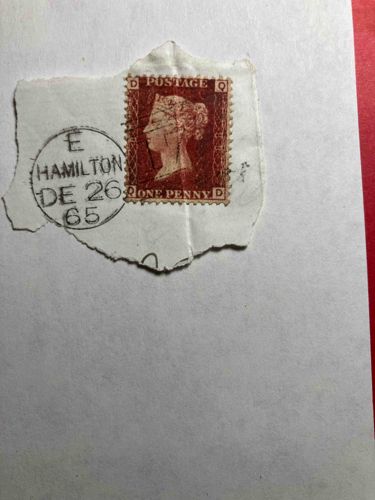
Victorian Great Britain Penny Red Postage Stamp on Paper Fragment

Philately / Antique Postage Stamps

AI Estimated Value

·Not an official valuation·Verify before acting

$5.00 - $12.00 USD

As of May 26, 2026

AI Item Analysis

·AI can make mistakes·Verify before acting
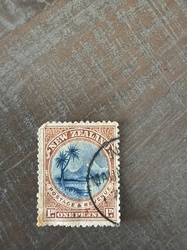
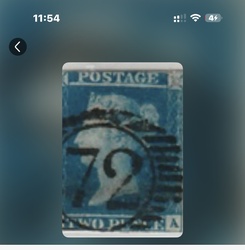
This item is a 19th-century British postage stamp, commonly known as a 'Penny Red,' still adhered to a fragment of the original cream-colored paper envelope (on-piece). The stamp features the profile of Queen Victoria facing left, rendered in a brownish-red or brick-red ink. It is perforated along all four edges, though the perforations show some minor irregularities and wear. Notable markings include the check letters 'D' and 'Q' in the upper corners and 'Q' and 'D' in the lower corners, which were used to identify the stamp's position on the printing plate. To the left of the stamp is a clear, circular black ink handstamp cancellation, or postmark, reading 'HAMILTON' at the top, 'DE 26' in the center, and '65' at the bottom, indicating it was processed in Hamilton (likely Scotland or Ontario, Canada, given the British Empire usage) on December 26, 1865. The paper fragment is irregularly torn with significant creasing and vertical folds that pass through the stamp itself. There are light pencil marks or notations to the right of the stamp. The stamp's surface shows evidence of use and aging, with some fading and surface accumulation, but the engine-turned background design remains visible, indicating the high-quality line-engraving process used by Perkins, Bacon & Co. during this era.
AI Appraisal Report

·AI can make mistakes·Verify before acting
Based on my visual examination of this Victorian Great Britain Penny Red, I have identified it as a Plate 71 or later issue (perforated with check letters in all four corners). The stamp is on-piece, featuring a 'HAMILTON' circular date stamp from December 26, 1865. While the stamp appears consistent with authentic Perkins, Bacon & Co. line-engraved issues from this era, its condition is significantly compromised. The vertical creasing and folds passing directly through the stamp diminish its philatelic value, as collectors prioritize 'fine' to 'very fine' examples with intact paper fibers and fresh color. The Penny Red was printed in the billions, making it one of the most common Victorian-era stamps; therefore, value is driven almost entirely by the plate number and postmark interest. The Hamilton cancellation is a standard postmark of the period. In the current market, single common-plate Penny Reds on fragments sell in high-volume lots or as affordable entry-level pieces. Factors such as the 'DQ' check letters and the 1865 date are common. Limitations of this digital appraisal include the inability to verify the watermark (likely Large Crown) or detect small repairs and hidden thins. A physical inspection using a watermark detector and a high-magnification loupe would be required to identify the specific plate number (found in the lace-work design), which could marginally increase the value if it were a rarer plate like 77 or 225. However, based on the visible 'DQ' placement and general appearance, this remains a low-value, high-supply specimen intended for topical or historical collections rather than investment-grade portfolios.

Get your items appraised

Instant estimates of your treasures with AI-powered appraisals

Browse More Appraisals