AI estimate as of July 30, 2025 · verify with a professional before acting
AI-Generated · Verify before acting
Everything on this page is generated by AI for informational purposes only. AI can make mistakes — the AI may misidentify items or misattribute them (artist, maker, brand, designer, origin, era). This is not an official valuation and should not be used for insurance, sale, tax, estate, legal, or lending purposes — or any decision requiring a certified appraisal. It is not an authoritative claim about any person, brand, or rights holder — do not share or rely on it as a factual statement about a third party. Always consult qualified professionals before making financial decisions.
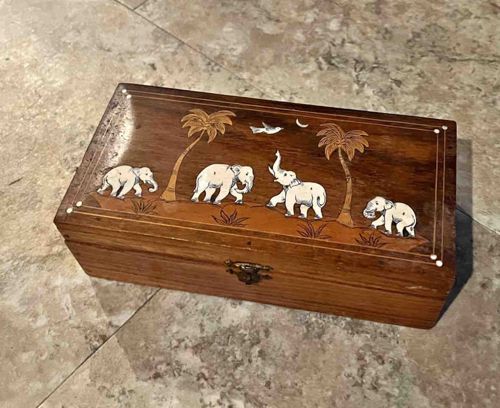
This is a rectangular wooden box, likely crafted from a medium to dark-toned hardwood such as teak or rosewood, known for its rich grain and durability. The most prominent feature is the intricate mother-of-pearl (or possibly bone/ivory substitute) inlay work on the top lid, depicting an exotic scene. The inlay portrays a group of five elephants of various sizes, suggesting a family or herd, amidst two stylized palm trees. There are also smaller inlaid elements, including what appears to be a bird and a crescent moon, positioned in the 'sky' portion of the lid. The ground plane below the elephants and trees is detailed with additional small vegetation inlays, possibly grass or small shrubs. The inlay pieces are predominantly white or cream-colored, contrasting sharply with the dark wood, and are precisely cut and fitted, indicating a good level of craftsmanship. The edges of the lid feature simple inlaid border lines with circular chấm, adding a decorative frame to the central scene. The box is secured by a brass or bronze-toned metal latch on the front, which exhibits some patina consistent with age. The overall condition shows signs of wear, particularly around the edges and corners with some minor scuffs and surface abrasions. There is visible surface wear or possibly a restoration attempt on the top left corner of the lid, where the finish appears lighter or scuffed. The wood itself has a natural luster, enhanced by a polished or varnished finish, which has aged gracefully. The construction appears to be mortise and tenon or a similar joinery method, suggesting a well-made functional piece. Given the style of the inlay and the material, it likely dates from the late 19th to early 20th century, possibly of Indian or Southeast Asian origin, where such intricate mother-of-pearl inlay techniques were common. The box would have been used for storing jewelry, keepsakes, or other small valuables.
AI Appraisal Report
Upon examining the provided image of this inlaid wooden keepsake box, I've assessed its condition and estimated its value. The box appears to be a late 19th to early 20th-century piece, likely from India or Southeast Asia, given the intricate mother-of-pearl (or bone/ivory substitute) inlay depicting elephants and palm trees. The craftsmanship is evident in the sharply contrasting, precisely cut, and fitted inlay pieces, which are a hallmark of quality for this type of decorative art. The brass or bronze-toned latch shows consistent patina with age. While the overall aesthetic is compelling, there are visible signs of wear, including scuffs, surface abrasions, and a notably lighter or scuffed area on the top left corner of the lid, suggesting past surface wear or a restoration attempt. These condition issues, while not severe, do impact the overall aesthetic appeal and, consequently, the market value. Market conditions for orientalist decorative arts and ethnic-themed boxes remain stable, but extreme rarity or exceptional condition drives the higher prices. Comparables for similar inlaid boxes in excellent condition can reach higher valuations. This box, showing moderate wear, would appeal to collectors of ethnographic art, decorative boxes, and those appreciating intricate inlay work. Demand is moderate, though specific animal motifs like elephants can sometimes garner higher interest. Factors significantly impacting value include the precise age, the authenticity of the inlay material (mother-of-pearl vs. bone/ivory substitute), and the extent of any repairs. Limitations in authenticity verification are significant from images alone; I cannot definitively confirm the inlay material, the precise age without wood analysis or construction details, or rule out modern reproductions. A physical inspection would be essential to verify the inlay material (differentiating mother-of-pearl from bone or plastic substitutes), thoroughly assess the wood type and joinery, examine the wear patterns under magnification for authenticity, and check for hidden repairs or alterations. Provenance documentation, if available, would significantly enhance authentication and value. Scientific testing, such as C14 dating for the wood, could provide a more precise age.