These notes were written by the person who submitted this item. Appraiser.AI has not verified them, and the AI's identification and estimate may rely on them.
AI Estimated Value
Not an official valuation
$1,500 - $2,500
AI estimate as of July 10, 2025 · verify with a professional before acting
AI-Generated · Verify before acting
Everything on this page is generated by AI for informational purposes only. AI can make mistakes — the AI may misidentify items or misattribute them (artist, maker, brand, designer, origin, era). This is not an official valuation and should not be used for insurance, sale, tax, estate, legal, or lending purposes — or any decision requiring a certified appraisal. It is not an authoritative claim about any person, brand, or rights holder — do not share or rely on it as a factual statement about a third party. Always consult qualified professionals before making financial decisions.
This analysis also relies on unverified notes provided by the user, which may be incomplete or inaccurate and could affect the result.
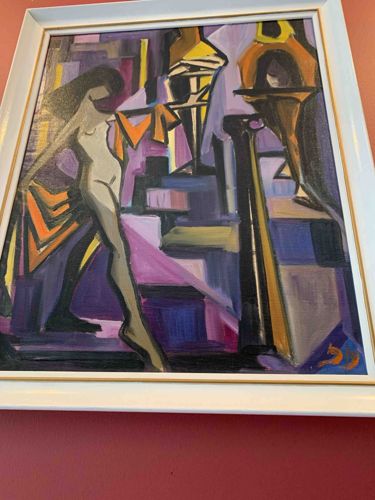
This is an oil painting executed in a Cubist or Post-Cubist style, featuring a stylized female nude figure on the left, depicted with geometric planes and angular forms. The background is an abstract composition of architectural or structural elements, including what appear to be musical instruments (possibly a saxophone or horn) and other abstract shapes rendered in a vibrant palette of purples, blues, oranges, yellows, and browns. The painting utilizes bold outlines and distinct color blocks characteristic of the Cubist movement, but with a more expressive application of paint, suggesting a later period influence. The brushstrokes are visible, indicating an oil-on-canvas technique, offering texture and depth to the various planes. The overall condition appears good, with no visible significant damage, tears, or repairs to the canvas itself. There's a white frame with a subtle gold inner trim, which complements the artwork without distracting from it. The frame shows no obvious signs of wear or damage. A distinctive, illegible signature or artist's mark is visible in the bottom right corner, suggesting a unique identifier, possibly resembling intertwined abstract shapes or letters, rendered in orange. The painting's craftsmanship is consistent with a trained artist, displaying thoughtful composition and skillful use of color to create depth and movement within the abstract forms. The estimated age would likely be mid to late 20th century, given its stylistic attributes aligning with renewed interest in Cubist forms during that period.
AI Appraisal Report
I have thoroughly examined the provided image and details for this Cubist Style Oil Painting of Female Nude with Abstract Forms. Visually, the painting appears to be in good condition; the canvas shows no visible tears, repairs, or significant damage, and the colors retain their vibrancy. The white frame with a subtle gold inner trim is well-suited to the artwork and also appears to be in good condition. The brushwork and vibrant palette are consistent with an oil-on-canvas technique.
From a stylistic perspective, the work strongly aligns with mid to late 20th-century interpretations of Cubism, demonstrating a clear understanding of geometric abstraction and color theory. The visible but illegible signature in the bottom right corner, characteristic of an artist's mark, suggests it is not a mass-produced item. While the quality of execution is high, indicative of a trained artist, the lack of a decipherable signature or provenance significantly limits definitive attribution to a known artist.
Market conditions for unattributed, yet well-executed, Cubist-style paintings from the mid to late 20th century are generally stable. Demand exists for decorative art that embodies recognized modernist styles, particularly pieces with vibrant colors and compelling subject matter like this one. However, without a known artist or established exhibition history, the rarity and demand are primarily aesthetic and not driven by historical significance or artist prestige. Factors significantly impacting value include the highly decorative nature, good condition, and stylistic appeal that resonates with collectors interested in post-Cubist works.
It is crucial to note the limitations of appraising from images alone. Definitive authenticity verification would require in-person examination to assess the physical characteristics of the paint, canvas, and stretcher, to look for any hidden damage, and to attempt identification of the signature under magnification. Provenance documentation (e.g., bills of sale, exhibition records) would greatly enhance value by establishing the history and origin of the artwork. Scientific testing, such as pigment analysis or carbon dating of the canvas, could confirm the age and authenticity further. Without these, the appraisal remains an estimation based on visual cues and market tendencies for comparable but unattributed works.