AI estimate as of August 4, 2025 · verify with a professional before acting
AI-Generated · Verify before acting
Everything on this page is generated by AI for informational purposes only. AI can make mistakes — the AI may misidentify items or misattribute them (artist, maker, brand, designer, origin, era). This is not an official valuation and should not be used for insurance, sale, tax, estate, legal, or lending purposes — or any decision requiring a certified appraisal. It is not an authoritative claim about any person, brand, or rights holder — do not share or rely on it as a factual statement about a third party. Always consult qualified professionals before making financial decisions.
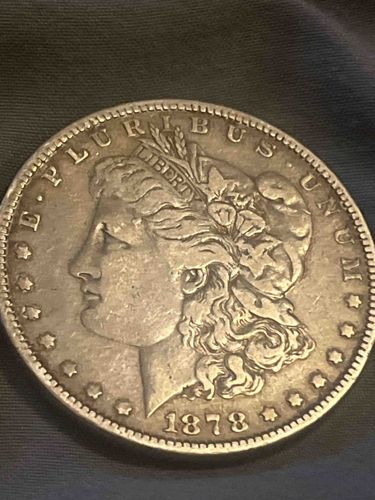
The item is a Morgan Silver Dollar, specifically the obverse (front) side of the coin. It is clearly dated 1878 at the bottom center. The coin depicts a left-facing profile of Lady Liberty, often referred to as the 'VAM' (Vector-Aligned Miss Liberty) variety or simply the Morgan portrait. She is adorned with a 'LIBERTY' headband, a cap, and various agricultural elements such as cotton and wheat in her hair, signifying prosperity and growth. The top rim of the coin features the inscription 'E PLURIBUS UNUM' (Out of many, one), with stars surrounding the lower edge of the coin, likely representing the states of the Union at the time of its mintage. The craftsmanship appears to be of high quality, typical for a United States Mint coin of this era. The coin exhibits noticeable wear consistent with circulation, particularly on the higher points of Liberty's portrait, such as her cheekbone, eyebrow, and the details of her hair and cap. There is also some slight discoloration and minor surface scratches visible, indicative of its age and handling. This wear contributes to a noticeable patina across the surface. The reeding along the edge is visible and appears mostly intact, though some areas may show flattening due to wear. No specific mint mark is discernible from this view, which would typically be located below the eagle on the reverse side. The condition suggests it is likely a circulated grade coin, perhaps Fine to Very Fine, but a definitive grade would require examination of both sides and in-hand assessment. This coin is an example of late 19th-century American numismatic artistry.
AI Appraisal Report
Upon examining the provided image of this 1878 Morgan Silver Dollar (Obverse), I can assess its condition and potential value. The coin is clearly a genuine Morgan Dollar, identifiable by the distinct portrait of Lady Liberty, the 'E PLURIBUS UNUM' motto, and the date. Its authenticity as a true 1878 coin is strongly indicated by the design elements.
The coin exhibits noticeable wear, particularly on the high points of Liberty's portrait, such as her cheekbone, eyebrow, and the details of her hair and cap. This wear, along with visible surface scratches and discoloration, is consistent with circulation over many years. I would place its current condition in the Fine (F) to Very Fine (VF) range. The reeding appears mostly intact. Without a view of the reverse, I cannot comment on the mint mark, which significantly impacts value.
Market conditions for common date Morgan Dollars in circulated grades are stable. The 1878 is a common date, especially for Philadelphia (no mint mark) issues. Demand for such coins is consistent among collectors, though rarity is low for this specific year and grade without special varieties. Factors impacting value here include the silver content (approximately 0.7735 troy ounces of 90% silver) and its collectibility. The wear is the primary factor limiting its value from reaching higher circulated or uncirculated prices.
While the image strongly suggests authenticity, a definitive verification requires in-person examination to assess the coin's weight, diameter, thickness, and edge reeding more precisely. Furthermore, a detailed magnification would confirm there are no signs of alteration or counterfeiting. Provenance documentation, though less common for circulated coins, would add another layer of security regarding its history. Scientific testing, such as specific gravity or metallurgical analysis, would be the ultimate verification, though often reserved for high-value or questionable pieces.