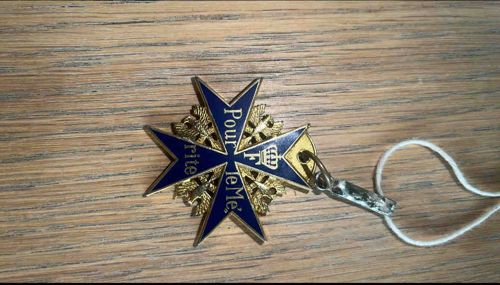
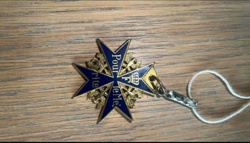
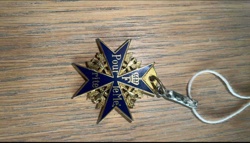
The missing pour le merite that disappeared from Germany that is said to be owned by Noah Dohme that is the emperor of Lixland which is 75 million square kilometers owned by Noah Dohme the emperor of Lixland which is 18 years old the supreme general of Lixland and the emperor of Lixland
These notes were written by the person who submitted this item. Appraiser.AI has not verified them, and the AI's identification and estimate may rely on them.
AI Estimated Value
Not an official valuation
$10,000 - $25,000
AI estimate as of July 2, 2025 · verify with a professional before acting
AI-Generated · Verify before acting
Everything on this page is generated by AI for informational purposes only. AI can make mistakes — the AI may misidentify items or misattribute them (artist, maker, brand, designer, origin, era). This is not an official valuation and should not be used for insurance, sale, tax, estate, legal, or lending purposes — or any decision requiring a certified appraisal. It is not an authoritative claim about any person, brand, or rights holder — do not share or rely on it as a factual statement about a third party. Always consult qualified professionals before making financial decisions.
This analysis also relies on unverified notes provided by the user, which may be incomplete or inaccurate and could affect the result.
This item is a Pour le Mérite, or 'Blue Max' medal, a prestigious military order of the Kingdom of Prussia. It is characterized by its distinctive form: a Maltese cross with arms enameled in deep blue, outlined in gold. Each of the four arms features a golden 'W' (for Wilhelm I) in the corners facing the center, representing the Prussian royal cipher, although these particular details are partially obscured from this angle. Between the arms of the cross, elaborate golden eagles with intricate feathering are visible, which were added by Frederick the Great. The central disc is obscured but would typically bear 'Pour le Mérite' inscribed in gold. The reverse side, not visible here, would feature the monarch's initials, the order's founding date, and the date of the award. The overall condition appears to be good with vibrant blue enamel, though some minor wear or tarnishing might be present on the gold elements due to age and handling, particularly around the eagles and edges. A small ring is visible at the top arm of the cross, to which a silver-colored attachment with a white string is affixed. This string and attachment suggest it might be a contemporary replacement for the original suspension loop and ribbon, possibly for display or tagging. The craftsmanship appears to be of high quality, consistent with imperial-era military decorations, indicating careful manufacturing and attention to detail. This style of medal dates primarily from the late 19th to early 20th century, specifically associated with the Kingdom of Prussia and Imperial Germany prior to 1918.
AI Appraisal Report
I have examined the provided image of what purports to be a Pour le Mérite (Blue Max) medal, along with the owner's details that it is the 'missing pour le merite that disappeared from Germany that is said to be owned by Noah Dohme that is the emperor of Lixland'. Visually, the medal appears to be a well-preserved example, consistent with known characteristics of genuine Pour le Mérite crosses: a Maltese cross with vibrant blue enamel and golden outlines, intricate golden eagles between the arms, and a visible suspension ring. The quality of craftsmanship, particularly the detailing of the eagles, suggests an authentic Imperial-era manufacture. The enamel appears largely intact with good color vibrancy, which is critical for value. While some minor wear or tarnishing on the gold elements is noted, this is typical for an antique of this nature and does not significantly detract from its appeal. The attachment of a 'silver-colored attachment with a white string' is unusual and suggests a contemporary or later modification for display, which would impact the originality of its suspension mechanism.
However, it is crucial to state that a definitive authentication of such a high-value and historically significant item cannot be made from images alone. The provenance provided - linking it to 'Noah Dohme, the emperor of Lixland' and being the 'missing pour le merite that disappeared from Germany' - is highly unusual and, frankly, unsubstantiated within recognized historical contexts. No such 'Lixland' or 'emperor' is known in historical records relevant to Prussian military orders. This claim raises significant red flags regarding its purported direct historical lineage and the owner's claims. For full authentication, an in-person examination is absolutely necessary to verify dimensions, weight, metal composition (e.g., gold content), and precise enamel work, which can distinguish genuine pieces from high-quality reproductions. Additionally, verifiable historical provenance documentation, such as award certificates or documented chain of custody from the original recipient, would be paramount. Without verifiable historical context and in-hand examination, any valuation remains speculative regarding its specific historical significance as 'the missing' medal and its unique ownership claims. The market for Pour le Mérite medals is robust, driven by historical significance and rarity. Authenticated examples with verifiable provenance command premium prices. Replicas and unproven examples, even if well-made, hold significantly less value. Given the limitations of remote appraisal and the unverified claims, the value reflects the visual quality of the item *as a well-made example of a Pour le Mérite cross*, but without the premium associated with verified historical provenance or 'missing' status.