These notes were written by the person who submitted this item. Appraiser.AI has not verified them, and the AI's identification and estimate may rely on them.
AI Estimated Value
Not an official valuation
$40-60
AI estimate as of August 12, 2025 · verify with a professional before acting
AI-Generated · Verify before acting
Everything on this page is generated by AI for informational purposes only. AI can make mistakes — the AI may misidentify items or misattribute them (artist, maker, brand, designer, origin, era). This is not an official valuation and should not be used for insurance, sale, tax, estate, legal, or lending purposes — or any decision requiring a certified appraisal. It is not an authoritative claim about any person, brand, or rights holder — do not share or rely on it as a factual statement about a third party. Always consult qualified professionals before making financial decisions.
This analysis also relies on unverified notes provided by the user, which may be incomplete or inaccurate and could affect the result.
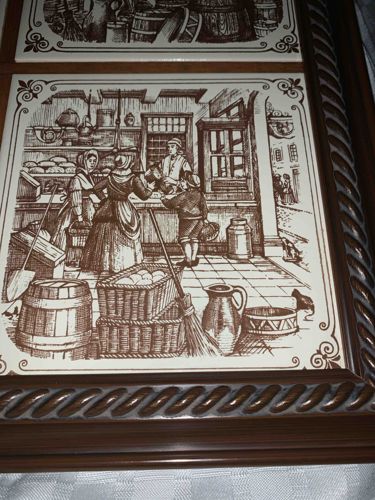
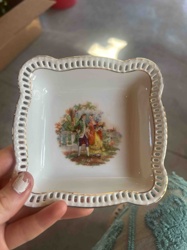
This item is a framed set of two Holland porcelain tiles, or potentially ceramic tiles with a porcelain-like finish, featuring sepia-toned, illustrative scenes. The tiles are white or off-white with dark brown (sepia) line drawings, giving them an antique or ethnographic aesthetic. Each tile is square or rectangular and is set within a dark brown wooden frame. The frame features a decorative rope or twisted pattern along its inner edge, adding to its traditional appearance. The upper tile, partially visible, depicts a scene that appears to involve figures and perhaps barrels, suggesting a domestic or trade-related setting. The lower, more clearly visible tile, portrays an interior scene of what seems to be a bakery or a general store, with multiple figures engaged in activities. One woman is at the counter, another is sweeping, and a man and a child are also present. Details include baskets, barrels, brooms, jugs, and what appear to be loaves of bread. The craftsmanship of the drawings is detailed, showing fine lines and hatching for shading, indicative of an engraving or etching style. The tiles themselves have a smooth glaze, and their edges appear clean. The overall condition appears good, with no obvious chips, cracks, or significant wear visible on the tiles. The frame also seems well-preserved with a consistent finish. The style of the illustration and the "Holland porcelain tile" context strongly suggest a Dutch-inspired, possibly Delftware-style, decorative piece, likely from the mid-20th century or later, replicating earlier artistic traditions. The intricate details and clear imagery indicate good quality manufacturing.
AI Appraisal Report
Upon examining the images provided of the framed Holland porcelain decorative tiles, I can assess the item as a charming decorative piece. The two sepia-toned tiles are set within a dark wood frame with a rope-twist inner border, presenting a cohesive and traditional aesthetic. The drawings, depicting Dutch domestic or commercial scenes, emulate the style of older engravings. The tiles appear to be in excellent condition, with no visible chips, cracks, or crazing, and the frame is similarly well-preserved. Based on the style, these are likely transfer-printed ceramic tiles, possibly from the mid to late 20th century, created for the decorative market rather than being antique Delftware. The term 'porcelain' might be used descriptively for its smooth, white finish. The value is primarily decorative. In the current market, similar framed sets of vintage Dutch-style decorative tiles are readily available. Their appeal lies in their rustic, Old World charm, which is popular for specific interior design schemes. Rarity is not a significant factor here; these were produced in considerable quantities. The primary value driver is their decorative quality and condition. Without a physical inspection, I cannot confirm the material (porcelain vs. ceramic), manufacturer's marks on the reverse, or the exact printing technique. Full authentication and dating would require examining the back of the tiles for any maker's mark and analyzing the tile body itself.