These notes were written by the person who submitted this item. Appraiser.AI has not verified them, and the AI's identification and estimate may rely on them.
AI Estimated Value
Not an official valuation
$800 - $1,500
AI estimate as of June 30, 2025 · verify with a professional before acting
AI-Generated · Verify before acting
Everything on this page is generated by AI for informational purposes only. AI can make mistakes — the AI may misidentify items or misattribute them (artist, maker, brand, designer, origin, era). This is not an official valuation and should not be used for insurance, sale, tax, estate, legal, or lending purposes — or any decision requiring a certified appraisal. It is not an authoritative claim about any person, brand, or rights holder — do not share or rely on it as a factual statement about a third party. Always consult qualified professionals before making financial decisions.
This analysis also relies on unverified notes provided by the user, which may be incomplete or inaccurate and could affect the result.
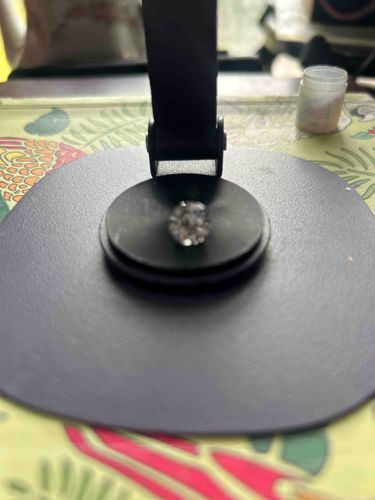
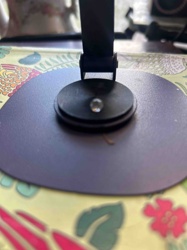
The item is a small, unmounted, faceted gemstone, exhibiting characteristics consistent with a polished diamond. It rests on a specialized black, circular display or examination stand, which features an articulating arm suggesting integrated lighting for optimal viewing. The stone appears to be a brilliant cut, most likely a round brilliant, designed to maximize light reflection and dispersion. Its color seems to fall within the near-colorless to very light tint range, potentially possessing subtle grey or brown undertones, though an accurate color grade cannot be ascertained from the image alone. The surface appears clean, and no significant visible inclusions, chips, or abrasions are discernible at the current resolution, indicating a generally good condition. As a loose stone, there are no visible mounting details or settings. No identifying marks, laser inscriptions, or unique manufacturing details are apparent through photographic inspection. The precise craftsmanship of the faceting, essential for the stone's brilliance and fire, appears standard for a modern cut. This piece is clearly intended as a component for fine jewelry or as a collectible specimen.
AI Appraisal Report
After careful visual examination of the provided image, I can offer the following preliminary appraisal for this loose gemstone. The item appears to be a small, polished, round brilliant cut diamond, exhibiting good brilliance and fire. From the image, the condition seems generally good, with no discernible chips, abrasions, or significant surface-visible inclusions, and the polish appears clean. Its color, while difficult to ascertain precisely from the photograph, seems to fall within the near-colorless to very light tint range, possibly with subtle grey or brown undertones. The faceting appears standard for a modern cut.
Regarding market conditions, loose diamonds are consistently in demand as components for fine jewelry. However, the exact value is highly contingent on the "4Cs": specific Carat weight, precise Color grade, detailed Clarity assessment, and accurate Cut quality analysis – none of which can be definitively determined solely from a photograph. Small diamonds of this apparent commercial quality are not considered rare. Current market value is also influenced by the increasing availability and popularity of lab-grown diamonds, which often offer a more affordable alternative.
It is critical to state the significant limitations of this appraisal. This assessment is based purely on visual inspection of an image. I cannot definitively verify its authenticity as a natural diamond; it could be a lab-grown diamond, a simulant (like moissanite or cubic zirconia), or a treated stone. To provide a precise and certified appraisal, an in-person examination is essential. This would allow for accurate carat weight measurement, detailed clarity and color grading under controlled lighting with professional magnification, and precise cut proportion analysis. Furthermore, scientific testing (e.g., spectroscopy, diamond testing) would be required to confirm natural origin and rule out any treatments, while provenance documentation would verify its history and ownership. Without these, the estimated value should be considered preliminary and speculative.