AI estimate as of June 23, 2025 · verify with a professional before acting
AI-Generated · Verify before acting
Everything on this page is generated by AI for informational purposes only. AI can make mistakes — the AI may misidentify items or misattribute them (artist, maker, brand, designer, origin, era). This is not an official valuation and should not be used for insurance, sale, tax, estate, legal, or lending purposes — or any decision requiring a certified appraisal. It is not an authoritative claim about any person, brand, or rights holder — do not share or rely on it as a factual statement about a third party. Always consult qualified professionals before making financial decisions.
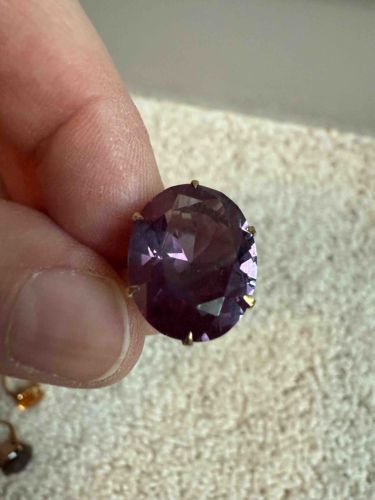
The item is a large, oval-cut synthetic amethyst or purple glass stone, likely part of a ring or brooch, given the visible prongs. The stone itself is a deep purple hue, with flashes of lighter lavender and fuchsia visible as light reflects off its facets. It exhibits a brilliant cut, designed to maximize sparkle and color saturation, featuring numerous triangular and kite-shaped facets on its crown and pavilion. The material appears highly transparent with no immediately visible inclusions, suggesting either a high-quality synthetic stone or very clean natural stone. The stone is held by at least four, possibly six, simple gold-toned prongs, which appear to be made of a yellow metal (possibly gold or gold-plated base metal) that is slightly discolored with age or wear. There are no clear maker's marks or stamps visible in the image. The overall style suggests it could be a costume jewelry piece or a more modest fine jewelry item likely from the mid to late 20th century, possibly 1950s-1980s, given its size and general aesthetic. The visible condition appears good, with no obvious chips or cracks on the stone. Some minor surface wear or scratches may be present consistent with handling and age, but these are not prominently discernible from the image.
AI Appraisal Report
Based on my visual examination of the image provided, this item features a large, oval-cut purple stone, likely an amethyst or purple glass, set in a prong setting. The stone appears to be brilliantly cut, maximizing light reflection and color display, with a deep, vibrant purple hue. Its transparency suggests either a high-quality synthetic or a very clean natural stone without visible inclusions. The setting consists of four to six gold-toned prongs, hinting at either gold or gold-plated metal, showing some signs of wear consistent with age. This piece's style, particularly its size and cut, points to a mid-to-late 20th-century origin, possibly between the 1950s and 1980s, characteristic of either costume or more modest fine jewelry. The condition appears good, with no obvious chips or cracks.For full authentication, a physical examination is crucial. This would allow me to conduct specific gravity and refractive index tests to confirm whether it is natural amethyst or synthetic material like glass or cubic zirconia. Examination of the metal for hallmarks would determine if it is gold, gold-plated, or another base metal. Without these in-person tests and provenance documentation, it is difficult to definitively assess authenticity and thus, market value. If it's a natural amethyst in a gold setting, its value would significantly increase. If it's glass in a base metal, it's primarily decorative.Demand for vintage jewelry is steady, but this specific type of large synthetic or glass stone piece is not rare given mass production methods of the era. If it's natural amethyst, it would hold more intrinsic value but still not be exceptionally rare given the prevalence of amethyst.Given these factors, and without further physical testing, my appraisal is primarily based on its aesthetic appeal and the assumption it is a well-made piece of its type. The primary limitations are the material identification of both the stone and metal, and the absence of any maker's marks visible in the image. Scientific testing would be needed to confirm the stone's genesis, and detailed hallmark inspection for the metal.