These notes were written by the person who submitted this item. Appraiser.AI has not verified them, and the AI's identification and estimate may rely on them.
AI Estimated Value
Not an official valuation
$20-40
AI estimate as of June 20, 2025 · verify with a professional before acting
AI-Generated · Verify before acting
Everything on this page is generated by AI for informational purposes only. AI can make mistakes — the AI may misidentify items or misattribute them (artist, maker, brand, designer, origin, era). This is not an official valuation and should not be used for insurance, sale, tax, estate, legal, or lending purposes — or any decision requiring a certified appraisal. It is not an authoritative claim about any person, brand, or rights holder — do not share or rely on it as a factual statement about a third party. Always consult qualified professionals before making financial decisions.
This analysis also relies on unverified notes provided by the user, which may be incomplete or inaccurate and could affect the result.
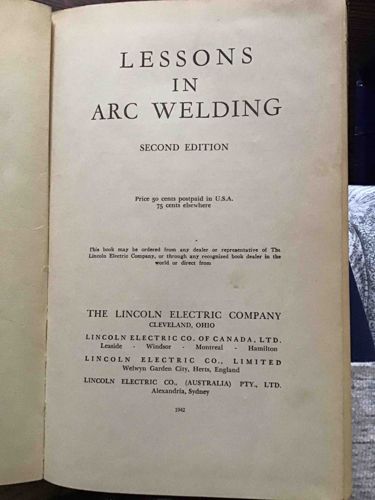
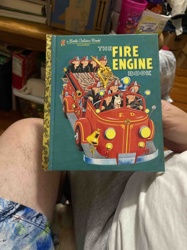
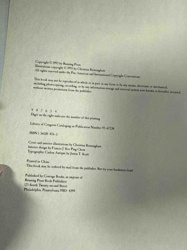
This item is the title page of a vintage instructional book titled "Lessons in Arc Welding," identified as the "SECOND EDITION." The page is made of what appears to be cream-colored paper, showing a slight discoloration consistent with age, suggesting a good overall condition with typical age-related patina rather than significant damage. The text is printed in a dark, likely black, ink. Prominently displayed is the publishing information, indicating that the book was produced by "THE LINCOLN ELECTRIC COMPANY" located in Cleveland, Ohio. Further details include distribution offices for Lincoln Electric in Canada (Leaside, Windsor, Montreal, Hamilton), the UK (Welwyn Garden City, Herts, England), and Australia (Alexandria, Sydney). A key historical detail is the publication year, clearly marked as "1942" at the bottom of the page, placing it squarely within the WWII era, a period of significant industrial growth and demand for skilled trades like welding. The original price is listed as "50 cents postpaid in U.S.A." and "75 cents elsewhere." While no explicit maker's marks or signatures are visible beyond the publisher's name, the association with a well-known industrial company like Lincoln Electric suggests a publication of high quality for its intended purpose. The overall aesthetic is utilitarian and educational, characteristic of technical manuals from the early to mid-20th century. The visible condition is good, with no apparent tears, creases, or major foxing, though the full extent of the book's condition cannot be assessed from this single page.
AI Appraisal Report
This "Lessons in Arc Welding, Second Edition" from 1942, published by The Lincoln Electric Company, appears to be in good condition based on the provided image of the title page and the owner's description. The slight discoloration consistent with age, without visible tears, creases, or major foxing, suggests it has been well-preserved. Its authenticity is supported by the clear publishing details and the prominent 1942 date, placing it within the significant industrial context of WWII. While typically not a high-value collectible, its age, specific historical period, and association with a prominent industrial manufacturer like Lincoln Electric give it some appeal to collectors of vintage technical manuals or WWII ephemera. Market comparables for similar industrial manuals from this era generally show modest values, typically under $50. Demand is niche; while not rare, items in good condition from this specific period have a steady, albeit small, market. The primary factors impacting its value are its good condition for its age and its historical context. However, without a physical examination of the entire book, I cannot verify the completeness of the pages, the condition of the binding, or the presence of any internal markings or damage. Full authentication would ideally involve in-person examination to confirm paper quality, print methods, and overall structural integrity, as well as checking for any potential reproductions. Provenance documentation, such as original purchase receipts if they existed, would further bolster authenticity, though this is rare for such utilitarian items.