AI estimate as of November 11, 2025 · verify with a professional before acting
AI-Generated · Verify before acting
Everything on this page is generated by AI for informational purposes only. AI can make mistakes — the AI may misidentify items or misattribute them (artist, maker, brand, designer, origin, era). This is not an official valuation and should not be used for insurance, sale, tax, estate, legal, or lending purposes — or any decision requiring a certified appraisal. It is not an authoritative claim about any person, brand, or rights holder — do not share or rely on it as a factual statement about a third party. Always consult qualified professionals before making financial decisions.
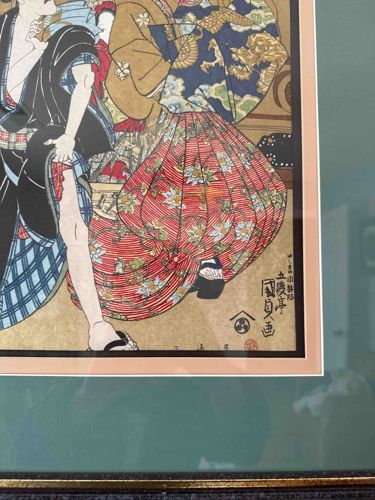
This item is a framed Japanese ukiyo-e woodblock print, depicting at least two figures in traditional Japanese attire. The print is characterized by its vibrant color palette, particularly striking in the rich reds, blues, khakis, and black, against a subtle golden-tan background. One prominent figure, partially shown, wears a voluminous, pleated skirt-like garment (possibly a hakama or part of a kimono ensemble) in a dominant red hue adorned with intricate floral patterns, primarily featuring white and green blossoms. The upper body of this figure, though mostly obscured, shows a blue garment with a golden, possibly dragon or cloud-like, motif. Another figure to the left wears a black outer garment over a blue and white patterned undergarment, revealing a pale leg and foot clad in a black sandal. The print exhibits characteristic ukiyo-e artistic conventions such as clean lines, flat areas of color, and dynamic composition. Visible along the right edge, just above the black border, are Japanese characters, likely the artist's signature, publisher's mark, or series title, hinting at its origin and potentially its specific title. The print appears to be in good condition, although encased behind glass, which prevents a detailed assessment of the paper's texture or any potential foxing, fading, or creasing. It is professionally matted with a light peach border and framed in what appears to be a dark metallic or wooden frame, behind glass. The style suggests it could date from the Edo period (17th to 19th century) or early Meiji period (late 19th century) when ukiyo-e was at its peak. The quality of the printing, evidenced by the clear registration of colors and fine detail in the patterns, indicates a high level of craftsmanship.
AI Appraisal Report
Upon visual examination of this framed ukiyo-e woodblock print, my assessment is based on the digital image provided. The print appears to be a genuine, well-executed example of Japanese ukiyo-e, likely from the Meiji period (late 19th century) or possibly a later-state Edo period print. The composition is dynamic, and the color registration on the garments, particularly the detailed red hakama and blue kimono, indicates skilled craftsmanship. The condition, viewed through glass, seems good, with vibrant colors and no immediately obvious signs of significant foxing, tearing, or water damage.
The market for ukiyo-e prints is mature. Pieces by renowned artists like Hokusai, Hiroshige, or Utamaro in good condition command very high prices. However, without a visible signature or publisher's mark that I can identify from the image, I must appraise this as a piece by a good but lesser-known artist or an unattributed work from a quality studio. The value is thus primarily in its decorative quality and craftsmanship. Comparable prints from this era by secondary artists, in good condition, typically sell in the $300 to $800 range at auction, depending on subject matter and collector interest.
This appraisal's primary limitation is the inability to perform a physical inspection. A full authentication would require removing the print from its frame to examine the paper for age-appropriate characteristics (e.g., chain lines), check for a publisher's seal or censor's mark on the margins, assess the print state (early vs. late printing), and check for any repairs or trimming. Provenance documentation would significantly aid in verification. Without this in-person analysis, it is impossible to rule out the possibility of it being a high-quality 20th-century reproduction, which would drastically lower its value.