AI estimate as of December 1, 2025 · verify with a professional before acting
AI-Generated · Verify before acting
Everything on this page is generated by AI for informational purposes only. AI can make mistakes — the AI may misidentify items or misattribute them (artist, maker, brand, designer, origin, era). This is not an official valuation and should not be used for insurance, sale, tax, estate, legal, or lending purposes — or any decision requiring a certified appraisal. It is not an authoritative claim about any person, brand, or rights holder — do not share or rely on it as a factual statement about a third party. Always consult qualified professionals before making financial decisions.
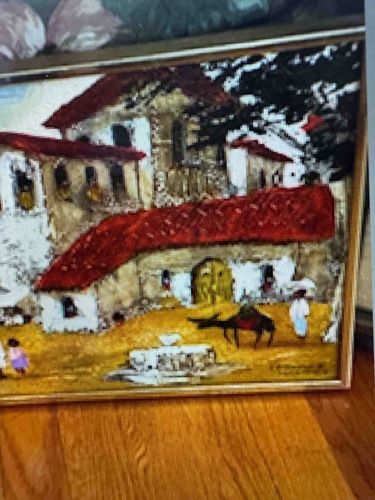
This item is an oil or acrylic painting depicting a vibrant village scene, likely Mediterranean or Latin American in origin, characterized by its heavily textured surface. The artwork is housed within a simple, narrow, light-colored wooden frame with a subtle golden hue, suggesting a traditional presentation. The painting itself features distinct brushstrokes and impasto techniques, giving a three-dimensional quality to the architectural elements and landscape. The composition is dominated by white or cream-colored stucco buildings with prominent, bright red terracotta-tiled roofs. One building in the foreground has a large, arched golden-yellow wooden door, and several windows with dark interiors are visible, some with small figures or objects. The ground is rendered in rich, warm tones of yellow and orange, suggesting dry earth or sand. In the mid-ground, a dark-colored animal, possibly a donkey or mule, is depicted alongside a figure in light-colored attire, carrying something on their head. Another smaller figure in purple is visible on the left side. A stone well or low wall structure appears in the foreground. The sky is a light blue, and dark green or black foliage, possibly cypress trees, frames the upper right portion of the scene. The overall style suggests a folk art or naive art influence, combined with a modernist approach to texture. The visible condition appears good, with no obvious signs of damage, tears, or significant discoloration, though the resolution of the image makes fine detail assessment difficult. The frame also appears intact without major dings or scratches. The age is estimated to be mid to late 20th century, given the style and common use of heavy texture in that period. There are no visible artist signatures or other markings discernible from the provided image, which would be crucial for a definitive appraisal.
AI Appraisal Report
I have examined the image of this textured painting depicting a Mediterranean/Village Scene. Visually, the condition appears good, with no obvious signs of damage, wear, or significant discoloration to the artwork itself. The impasto technique, which creates the heavy texture, seems intact. The simple, light-colored wooden frame also appears to be in good condition.
Authenticity is difficult to ascertain from an image alone. There are no visible artist signatures or other identifying marks, which significantly limits a definitive attribution. The style, while charming and evocative of folk or naive art coupled with modernist texture, is not unique enough to immediately suggest a known artist without a signature or provenance.
Market conditions for unsigned decorative textured art of this nature typically place it in a moderate value range. Comparable works often sell based on their aesthetic appeal and suitability for interior design rather than artistic provenance. Demand for such pieces is steady among buyers looking for unique wall decor, but rarity is low given the prevalence of similar works from the mid to late 20th century.
Factors significantly impacting value include the lack of a discernible artist's signature, which prevents attributing it to a listed artist. If a signature were present and identifiable, the value could increase considerably. Without it, it's largely valued as a decorative piece.
For full authentication, an in-person examination would be crucial to look for faint signatures, labels on the verso, and to assess the exact medium and technique. Provenance documentation (e.g., bills of sale, exhibition catalogs) or scientific testing (pigment analysis) would be essential to confirm authorship and age, neither of which can be determined from an image.