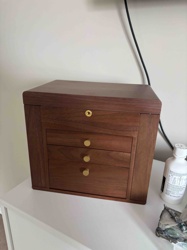
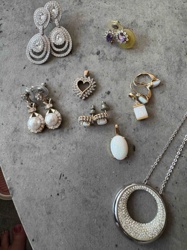
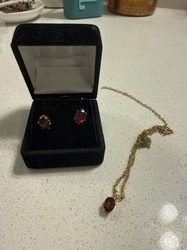
These notes were written by the person who submitted this item. Appraiser.AI has not verified them, and the AI's identification and estimate may rely on them.
AI Estimated Value
Not an official valuation
$150-300
AI estimate as of July 7, 2025 · verify with a professional before acting
AI-Generated · Verify before acting
Everything on this page is generated by AI for informational purposes only. AI can make mistakes — the AI may misidentify items or misattribute them (artist, maker, brand, designer, origin, era). This is not an official valuation and should not be used for insurance, sale, tax, estate, legal, or lending purposes — or any decision requiring a certified appraisal. It is not an authoritative claim about any person, brand, or rights holder — do not share or rely on it as a factual statement about a third party. Always consult qualified professionals before making financial decisions.
This analysis also relies on unverified notes provided by the user, which may be incomplete or inaccurate and could affect the result.
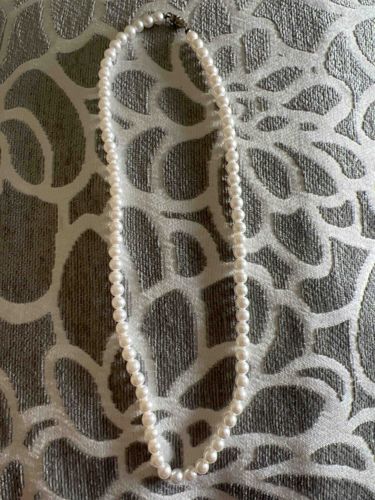
The item is a single strand pearl necklace, approximately choker to princess length. It is composed of numerous small, uniformly sized white pearls, likely cultured or simulated, that appear to be round to near-round in shape. Each pearl exhibits a soft, slightly iridescent luster, typical of natural or cultured pearls, though the resolution does not permit confirmation of individual nacre thickness or surface blemishes. The pearls are individually knotted on a white thread, a common practice to prevent loss of all pearls if the strand breaks and to minimize abrasion between pearls. The stringing appears well-executed, with consistent spacing between knots. The necklace is secured by a visible clasp at one end, which appears to be a basic metal (possibly silver-toned or white gold-toned) box or tab-insert clasp, showing minimal wear or tarnish from the visible angle. There are no discernible maker's marks or signatures visible in the image. Given its classic design and the smaller size of the pearls, it likely dates from the mid to late 20th century, a period when such pearl necklaces were very popular, or could be a more contemporary production imitating that style. The overall condition appears to be good, with no obvious signs of significant damage, discoloration, or missing pearls. The craftsmanship seems standard for mass-produced pearl jewelry, focusing on consistent pearl size and neat stringing.
AI Appraisal Report
I have examined the Single Strand White Pearl Necklace based on the provided image and description. Visually, the necklace appears to be in good condition, with uniform small white pearls, consistent knotting, and a functional clasp. The pearls exhibit a soft luster, common for cultured or simulated pearls. Authenticity regarding whether these are natural, cultured, or simulated pearls cannot be definitively confirmed from an image. A direct examination would allow me to assess nacre thickness, surface characteristics under magnification, and perform basic tests like the 'tooth test' to distinguish between natural/cultured and simulated pearls. Given the classic design and small pearl size, it aligns with widespread production from the mid to late 20th century, a period of high demand for such pieces. While there's a steady demand for classic pearl jewelry, smaller, uniformly sized white pearl necklaces are relatively common, affecting rarity. The lack of maker's marks or distinguishing features, combined with the apparent basic clasp, suggests it is a mass-produced item rather than a high-end designer piece. Factors significantly impacting value include whether the pearls are natural (highest value), cultured (moderate), or simulated (lowest), and the quality of the nacre, luster, and surface blemishes. Without in-person inspection to confirm the pearl type, identify any treatments, and verify the clasp material, the appraisal remains an estimate. Provenance documentation (e.g., original sales receipts, gemological certificates) or scientific testing (e.g., X-radiography for growth structures, Raman spectroscopy for composition) would be essential for full authentication and a more precise valuation.