AI estimate as of December 14, 2025 · verify with a professional before acting
AI-Generated · Verify before acting
Everything on this page is generated by AI for informational purposes only. AI can make mistakes — the AI may misidentify items or misattribute them (artist, maker, brand, designer, origin, era). This is not an official valuation and should not be used for insurance, sale, tax, estate, legal, or lending purposes — or any decision requiring a certified appraisal. It is not an authoritative claim about any person, brand, or rights holder — do not share or rely on it as a factual statement about a third party. Always consult qualified professionals before making financial decisions.
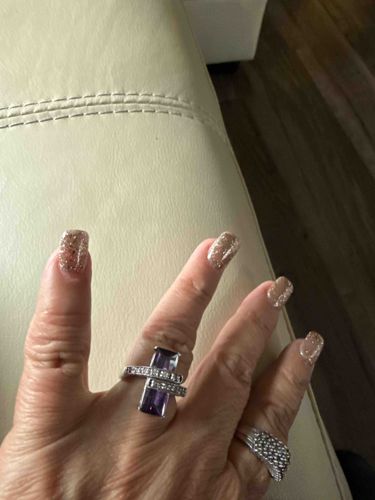
This item is a statement ring featuring a striking bypass design, likely crafted from white gold or sterling silver, given its bright, silvery luster. The central focus is a large, rectangular, emerald-cut amethyst gemstone, characterized by its deep purple hue with visible purple zoning, suggesting a natural origin. The amethyst is oriented vertically on the finger. Flanking and crossing over the amethyst are two bands, each pave-set with numerous small, round brilliant-cut diamonds or diamond simulants. These pave settings create a sparkling contrast against the smooth surface of the amethyst. The overall design emphasizes a modern aesthetic, possibly dating from the late 20th century to contemporary. The ring appears to be in good condition with no immediately visible damage such as chips or cracks to the amethyst, nor any missing pave stones. The metal shows a clean, polished finish with minimal signs of wear or tarnishing. The craftsmanship appears to be of good quality, with stones set securely, indicating a well-made piece of fine or fashion jewelry.
AI Appraisal Report
I have carefully examined the provided image of this Amethyst and Diamond Bypass Ring. Visually, the ring appears to be in good to very good condition. The large, emerald-cut amethyst exhibits a pleasing deep purple hue with visible color zoning, consistent with a natural stone. I detect no immediate chips, cracks, or abrasions on the amethyst, and its vertical orientation is a strong design element. The surrounding pave-set stones, described as diamonds or diamond simulants, appear intact with no missing stones, contributing significant sparkle to the piece. The metal exhibits a clean, polished finish, suggesting either white gold or sterling silver, and shows minimal signs of wear or tarnishing.
Authenticity of the amethyst as natural is strongly suggested by its color and zoning, though without physical examination, I cannot definitively rule out synthetic alternatives or treatments. More critically, the identity of the smaller pave stones cannot be confirmed from an image alone. They could be diamonds, white sapphires, cubic zirconia, or other simulants. This significantly impacts the overall value.
Market conditions for amethyst jewelry are generally stable, with demand driven by its attractive color and reasonable price point. Bypass designs are popular and timeless. For a piece of this type with a natural amethyst and if the smaller stones are indeed genuine diamonds, the value would lean towards the higher end of my estimate. If they are simulants, the value would be considerably lower.
To fully authenticate this piece, an in-person examination by a gemologist is crucial. This would involve specific gravity testing and refractometer readings for the amethyst, and diamond testing (thermal and electrical conductivity) for the pave stones. A metal hallmark inspection would also confirm material purity. Providing provenance documentation, such as a previous appraisal or purchase receipt, would also greatly aid in authentication and valuation.