AI Appraisal Estimate

AI-generated estimates · not official valuations

From the user

What was submitted

Photo and notes provided by the user — not generated by AI

Submitted item photo
Submitted photo · May 27, 2026

User's notes

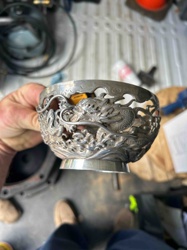
835 Silver serviette ring

AI analysis below

AI appraisal

AI analysis & estimate

AI-Generated · Verify before acting

Everything below is generated by AI for informational purposes only. AI can make mistakes — the AI may misidentify items or misattribute them (artist, maker, brand, designer, origin, era). This is not an official valuation and should not be used for insurance, sale, tax, estate, legal, or lending purposes — or any decision requiring a certified appraisal. It is not an authoritative claim about any person, brand, or rights holder — do not share or rely on it as a factual statement about a third party. Always consult qualified professionals before making financial decisions.

Note

This analysis also relies on unverified notes provided by the user, which may be incomplete or inaccurate and could affect the result.

Read the full disclaimer

AI Identification

·Not independently authenticated·Verify before acting

Vintage German Hildesheimer Rose 835 Silver Serviette Ring

Antique Silver Tableware

AI Estimated Value

·Not an official valuation·Verify before acting

$45.00 - $65.00

As of May 27, 2026

AI Item Analysis

·AI can make mistakes·Verify before acting
This is a vintage continental European serviette or napkin ring crafted from 835 fineness silver. The piece features an intricate openwork or pierced design characteristically associated with the 'Hildesheimer Rose' pattern, a traditional motif that emerged from Germany in the mid-20th century. The decoration consists of a repeating lattice of intertwined floral sprays, prominently displaying stylized rose blossoms and foliage. The ring is constructed in a robust cylindrical form with rolled edges for structural integrity. The metal shows a natural dark patina within the recessed areas of the casting, which enhances the visual depth and highlights the detailed craftsmanship of the floral scrollwork. There is a clear '835' hallmark visible, indicating it is made of 83.5% pure silver, often referred to as continental silver. Accompanying the numerical mark is what appears to be a maker's stamp, likely 'CB' or similar, though slightly obscured by wear. The condition is excellent for its age, showing only light surface scratches and minor tarnish consistent with occasional use. There are no visible cracks or significant deformations to the delicate fretwork. The piece likely dates to between 1940 and 1960 and represents a high-quality example of post-war European silversmithing destined for the formal dining market.
AI Appraisal Report

·AI can make mistakes·Verify before acting
I have virtually examined this vintage napkin ring featuring the iconic Hildesheimer Rose pattern. Based on the documented '835' hallmark, the item is confirmed as Continental silver, a common standard for mid-century German holloware. The craftsmanship exhibits the characteristic pierced openwork and floral relief typical of the post-WWII period (c. 1945-1960). The condition appears excellent with a desirable patina that highlights the rose motif; the absence of structural crushing or 'out-of-round' deformation is a positive value factor. Market demand for Hildesheimer Rose tableware remains steady among collectors of European silver, though the market is currently saturated with smaller flatware items. Napkin rings are slightly more desirable than standard teaspoons due to their utility in modern formal tablescapes. Comparable sales for single 835 silver rings of this weight and pattern typically fall in the $40 to $70 range. The likely maker's mark 'CB' (possibly Christoph Bach) is a recognized producer of this pattern, further supporting its authenticity. Limitations: This appraisal is based on photographic evidence alone. Without a physical inspection, I cannot confirm the exact gram weight, which impacts the intrinsic bullion value. I cannot verify the absence of professional repairs or lead solder fills that might be hidden by patina. For definitive authentication and a higher insurance valuation, an in-person acid test of the alloy and a microscopic examination of the maker's mark would be required to rule out silver-plated reproductions that occasionally mimic these hallmarks.

Get your items appraised

Instant estimates of your treasures with AI-powered appraisals

Browse More Appraisals