AI estimate as of November 2, 2025 · verify with a professional before acting
AI-Generated · Verify before acting
Everything on this page is generated by AI for informational purposes only. AI can make mistakes — the AI may misidentify items or misattribute them (artist, maker, brand, designer, origin, era). This is not an official valuation and should not be used for insurance, sale, tax, estate, legal, or lending purposes — or any decision requiring a certified appraisal. It is not an authoritative claim about any person, brand, or rights holder — do not share or rely on it as a factual statement about a third party. Always consult qualified professionals before making financial decisions.
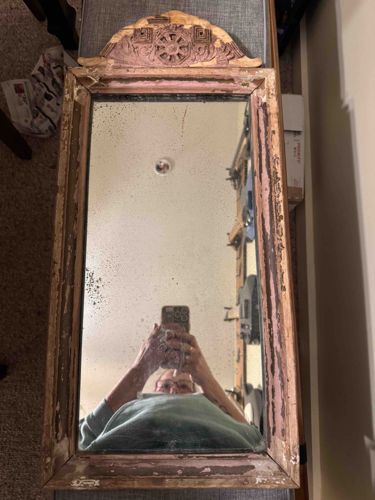
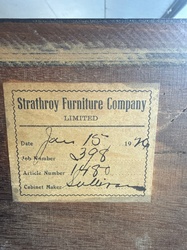
This appears to be an antique wall mirror, likely from the late 19th or early 20th century, characterized by its richly carved wooden frame and ornate pediment. The overall dimensions suggest a medium-sized rectangular shape, suitable for a hall or boudoir. The frame is constructed from wood, with visible signs of distressed and flaking paint, predominantly in shades of faded pink and gold, revealing the natural wood color underneath in many areas. The most striking feature is the pediment at the top, which exhibits intricate hand-carved details including a central medallion-like motif or rosette surrounded by geometric and foliate patterns. The carving work suggests a good level of craftsmanship, indicative of a period where such decorative elements were highly valued. The mirror glass itself shows significant signs of age, including widespread 'desilvering' or 'mirror rot,' manifesting as numerous dark spots and speckles across the reflective surface. There is also a visible crack or scratch on the upper left side of the mirror plate. This deterioration of the silvering is a common characteristic of older mirrors and contributes to its antique aesthetic. The condition suggests that while the frame retains its structural integrity, the surface finishes are heavily aged with significant paint loss and chipping, creating a 'shabby chic' or weathered look. There are no immediately visible maker's marks or signatures in the provided images, but the style of carving and the mirror's condition are consistent with decorative arts from the Victorian or Edwardian eras. The back of the mirror is not clearly visible, preventing assessment of hanging hardware or backing material. The overall impression is one of an item with considerable history and a strong vintage appeal.
AI Appraisal Report
Upon visual examination of this antique wall mirror, its characteristics strongly suggest a late 19th or early 20th-century origin, possibly in the Victorian or Edwardian style. The frame's construction and the intricately hand-carved pediment, featuring foliate and geometric motifs, point to a period of skilled craftsmanship. The overall condition is best described as 'fair' to 'distressed,' which significantly impacts its value. While the carved wood frame appears structurally sound, the surface finish exhibits extensive flaking, chipping, and paint loss, creating a pronounced 'shabby chic' aesthetic. This distressed look is popular with a specific segment of the interior design market, but it detracts from its value for collectors seeking pristine period pieces.
The most significant factor diminishing its value is the condition of the mirror plate itself. The widespread 'desilvering' or 'mirror rot,' along with a visible crack, renders it largely non-functional for reflection and is considered severe damage. While some aging is expected, the extent of this deterioration is substantial. Current market comparables for similar carved mirrors from this era show a wide price range. Mirrors with original, intact silvering command premium prices, often exceeding $1,000. However, those with heavily distressed frames and damaged glass, like this example, typically sell for significantly less. The primary value now lies in the decorative quality of the frame itself. Demand for items in this 'shabby chic' condition is steady but not as strong as for well-preserved antiques.
It is important to note that this appraisal is based solely on images. A full authentication would require an in-person examination to identify potential maker's marks, analyze the wood type and construction techniques, and assess the backboard and hanging hardware. Without provenance documentation or physical inspection, I cannot definitively confirm the age, maker, or origin.