AI Appraisal Estimate

AI-generated estimates · not official valuations

From the user

What was submitted

Photo and notes provided by the user — not generated by AI

Submitted item photo
Submitted photo · June 25, 2026

User's notes

No additional notes provided.

AI analysis below

AI appraisal

AI analysis & estimate

AI-Generated · Verify before acting

Everything below is generated by AI for informational purposes only. AI can make mistakes — the AI may misidentify items or misattribute them (artist, maker, brand, designer, origin, era). This is not an official valuation and should not be used for insurance, sale, tax, estate, legal, or lending purposes — or any decision requiring a certified appraisal. It is not an authoritative claim about any person, brand, or rights holder — do not share or rely on it as a factual statement about a third party. Always consult qualified professionals before making financial decisions.

Read the full disclaimer

AI Identification

·Not independently authenticated·Verify before acting

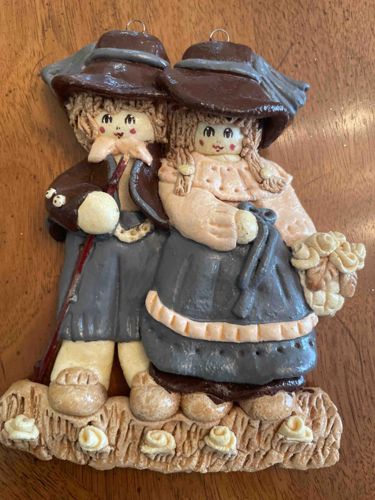
Handmade Clay Dough Hanging Figurine of a Boy and Girl

Home Decor / Folk Art Figurine

AI Estimated Value

·Not an official valuation·Verify before acting

$45-65

As of June 25, 2026

AI Item Analysis

·AI can make mistakes·Verify before acting
This is a handmade wall-hanging or ornament figurine crafted from what appears to be salt dough or polymer clay, subsequently painted and varnished. The piece depicts two children, a boy and a girl, in folk-style attire. The boy wears a wide-brimmed brown hat with a grey feather, a brown jacket over a tan shirt, and grey trousers. The girl features blonde braided hair under a matching hat, wearing a cream sweater with a grey skirt accented by a tan ruffled hem. Both figures are standing on a textured tan base decorated with small white rosettes. The piece has a distinct glossy finish, likely from a clear lacquer or varnish coating. Notable features include hand-painted facial details with small red cheek dots and simple line-work for the eyes and mouth. The construction shows signs of hand-molding, such as the textured 'knit' pattern on the sweaters and the incised lines on the base and hats. Two small wire loops are embedded into the tops of the hats for hanging. The item shows some signs of age, including minor yellowing of the varnish and small areas of paint wear, specifically on the boy's cane and the edges of the base. This style of folk craft was particularly popular in the 1980s and early 1990s as home decor. No visible maker's marks or signatures are present, suggesting it is a high-quality artisan-crafted piece or a well-executed hobbyist project.
AI Appraisal Report

·AI can make mistakes·Verify before acting
I have conducted a visual inspection of this handmade clay dough hanging figurine. The piece exhibits characteristics typical of late 20th-century salt dough or polymer clay craft, a genre that reached peak popularity in the 1980s. The execution—including the incised textures on the hats and knit-pattern sweaters—demonstrates a high level of hobbyist skill or small-scale artisan production. The condition is fair to good; while the gloss varnish has likely preserved the integrity of the material, I observe characteristic age-related yellowing and slight abrasions on the boy's cane and base edges. The market for unsigned salt-dough folk art is currently niche, dominated by collectors of nostalgic Americana and farmhouse decor. Comparables often sell at local craft markets or online vintage platforms (like Etsy or eBay) in the $30 to $80 range, depending on complexity and preservation. The lack of a maker's mark limits its value as a 'collected' artisan piece, though its charm and size lend it decorative utility. Limitations: Digital images cannot confirm the internal structure or the exact stability of the wire loops. Without a physical inspection, I cannot assess if the dough has internal moisture damage or if it has been treated for pest prevention. To provide a definitive authentication of age or material composition, an in-person examination would be required to test for chemical stabilizers or to verify the presence of proprietary clay markers popular in that era.

Get your items appraised

Instant estimates of your treasures with AI-powered appraisals

Browse More Appraisals