AI estimate as of October 30, 2025 · verify with a professional before acting
AI-Generated · Verify before acting
Everything on this page is generated by AI for informational purposes only. AI can make mistakes — the AI may misidentify items or misattribute them (artist, maker, brand, designer, origin, era). This is not an official valuation and should not be used for insurance, sale, tax, estate, legal, or lending purposes — or any decision requiring a certified appraisal. It is not an authoritative claim about any person, brand, or rights holder — do not share or rely on it as a factual statement about a third party. Always consult qualified professionals before making financial decisions.
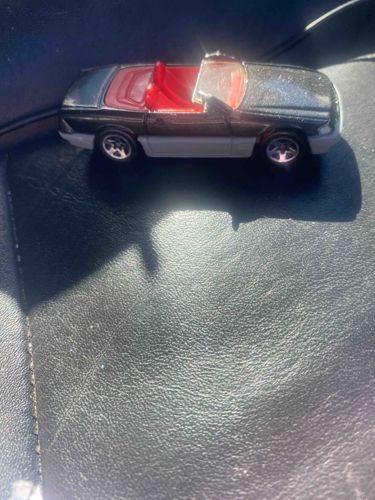
This item is a die-cast toy car, appearing to be a convertible model, likely from the late 20th or early 21st century. It features a dark grey or black upper body with a lighter grey lower body molding, suggesting a two-tone paint scheme. The interior is a striking bright red, contrasting sharply with the exterior colors. The windshield is made of a clear, possibly plastic, material. The wheels are silver-colored, five-spoke design, with what appear to be black 'tires' which are likely part of the wheel molding. The overall construction suggests it is made of metal (die-cast) for the body and plastic for the interior and windshield. There are no obvious manufacturer's marks visible in the provided image, but it strongly resembles models produced by brands like Hot Wheels or Matchbox due to its size and general style. The condition appears to be used, with some visible dust or dirt on the exterior surfaces and slight scuffs that suggest playwear. No severe damage such as dents or missing parts is immediately apparent, though closer inspection would be required for a definitive assessment. The craftsmanship is typical for mass-produced toy cars of this type, focusing on replicating a vehicle silhouette rather than intricate details, yet it maintains a recognizable form of a convertible sports car.
AI Appraisal Report
Upon visual examination of the provided image, I assess this die-cast convertible car toy. The condition appears to be used, exhibiting some dust and minor scuffs consistent with playwear. There are no immediate signs of severe damage such as dents or missing parts. Authenticity, based on style and apparent scale, strongly suggests this is a mass-produced toy, likely from a major manufacturer like Hot Wheels or Matchbox, or a similar brand from the late 20th or early 21st century. However, without visible manufacturer's marks or specific model identifiers, definitive attribution or 'authenticity' beyond being a genuine die-cast toy car is impossible from images alone.
Market conditions for such items are generally modest. Comparables, typically found in children's toy aisles or as common collectibles, rarely command high prices unless they are rare variations, first editions, or in pristine, unopened packaging. This item, being used and unboxed, falls into the common collectible category. Demand for generic, used die-cast cars is low, with widespread availability. Rarity is not a factor here; this appears to be a standard production toy.
Factors significantly impacting value are largely negative: the used condition, lack of original packaging, and the absence of clear manufacturer identification or specific model rarity. The lack of detailed craftsmanship, typical for mass-produced toys, also limits its collectible appeal.
Limitations in authenticity verification are significant. A complete assessment would require in-person examination to locate any manufacturer's marks on the chassis, determine the exact scale, and assess the true extent of wear. Provenance documentation (e.g., original packaging, purchase receipts) would definitively link it to a specific brand and model. Scientific testing is not applicable here, as it's a mass-produced toy, not a fine art piece.