AI Appraisal Estimate

AI-generated estimates · not official valuations

From the user

What was submitted

Photo and notes provided by the user — not generated by AI

Submitted item photo
Submitted photo · June 6, 2026

User's notes

No additional notes provided.

AI analysis below

AI appraisal

AI analysis & estimate

AI-Generated · Verify before acting

Everything below is generated by AI for informational purposes only. AI can make mistakes — the AI may misidentify items or misattribute them (artist, maker, brand, designer, origin, era). This is not an official valuation and should not be used for insurance, sale, tax, estate, legal, or lending purposes — or any decision requiring a certified appraisal. It is not an authoritative claim about any person, brand, or rights holder — do not share or rely on it as a factual statement about a third party. Always consult qualified professionals before making financial decisions.

Read the full disclaimer

AI Identification

·Not independently authenticated·Verify before acting

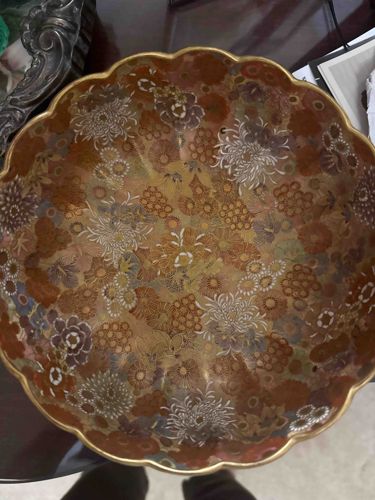
Japanese Satsuma Millefleurs Scalloped Bowl

Asian Antiques - Japanese Ceramics

AI Estimated Value

·Not an official valuation·Verify before acting

$800 - $1,200

As of June 6, 2026

AI Item Analysis

·AI can make mistakes·Verify before acting
A fine Japanese Satsuma earthenware bowl, likely dating to the late Meiji (1868-1912) or Taisho period. The bowl features a classic lobed or scalloped rim, typical of higher-end Export period ceramics. Its interior is densely decorated in the 'millefleurs' or 'thousand flowers' pattern, showcasing a complex tapestry of meticulously hand-painted chrysanthemums and other floral motifs in a rich palette of iron-red, gold gilt, cream, and muted earth tones. The craftsmanship is evident in the fine moriage (raised enamel) techniques and the delicate gold highlighting that outlines individual petals and leaves. Physical construction appears to be a fine cream-colored stoneware with a characteristic crackle glaze beneath the polychrome enamels. The use of gold leaf suggests a high-quality production intended for the international market. Condition-wise, the bowl exhibits minor rubbing to the gilt on the scalloped rim and slight surface wear consistent with age, but no visible chips, cracks, or structural repairs are evident from this perspective. The dense packing of the floral elements shows great skill in composition, with varying sizes of blooms creating a sense of depth and luxury characteristic of the Satsuma style.
AI Appraisal Report

·AI can make mistakes·Verify before acting
I have conducted a visual analysis of this Japanese Satsuma earthenware millefleurs bowl. The piece exhibits the characteristic cream-colored crackle glaze and dense polychrome floral decoration indicative of the late Meiji to early Taisho periods (circa 1890–1920). The craftsmanship is of high quality, featuring precise millefleurs (thousand flowers) execution and fine moriage enamel work. The scalloped rim and intensive use of gold gilt suggest it was produced by a reputable workshop such as Kinkozan or Ryozan for the export market. Visually, the condition appears excellent, with minor gilt rubbing on the rim consistent with its age, though the absence of structural cracks or chips is a significant value driver. The market for fine Meiji-period Satsuma remains stable, particularly for complex floral motifs which are highly collectible. Recent auction results for similar 5-7 inch scalloped bowls range between $700 and $1,500 depending on the presence of a signature and the density of the pattern. However, as this appraisal is based on digital images, there are limitations. I cannot confirm the presence of a signature on the base or verify the integrity of the glaze under UV light to check for professional restorations. For full authentication, an in-person examination is required to feel the weight and texture of the enamels. Provenance documentation or a clear photograph of the base mark would further refine this valuation. Final authentication would depend on verifying that the depth of the enameling and the quality of the clay body align with period standards.

Get your items appraised

Instant estimates of your treasures with AI-powered appraisals

Browse More Appraisals