AI estimate as of August 7, 2025 · verify with a professional before acting
AI-Generated · Verify before acting
Everything on this page is generated by AI for informational purposes only. AI can make mistakes — the AI may misidentify items or misattribute them (artist, maker, brand, designer, origin, era). This is not an official valuation and should not be used for insurance, sale, tax, estate, legal, or lending purposes — or any decision requiring a certified appraisal. It is not an authoritative claim about any person, brand, or rights holder — do not share or rely on it as a factual statement about a third party. Always consult qualified professionals before making financial decisions.
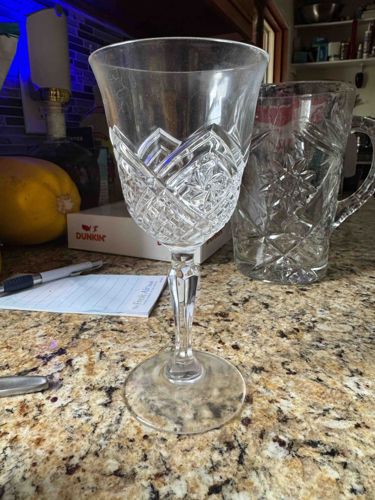
This is a clear glass goblet, likely made of lead crystal or high-quality glass, standing approximately 8-10 inches tall based on its proportion next to common household items. Its most prominent features are the intricate cut glass patterns on the bowl. The upper portion of the bowl is smooth and undecorated, while the lower two-thirds are adorned with a meticulously cut cross-hatch or diamond pattern that creates a textured, prismatic effect. Within this larger pattern, individual starburst or floral motifs are discernible, indicative of deliberate craftsmanship. The stem is faceted, adding further visual interest and light refraction, and appears solid or thick, giving it a sturdy appearance. The base is a simple, clear circular foot, proportional to the goblet's height, designed for stability. There are no immediately visible chips, cracks, or significant damage, suggesting it is in good to very good condition, though some dust or smudges are present on the surface, which is common for an item not actively in use or recently cleaned. No obvious maker's marks, signatures, or stamps are visible in the provided image. The design suggests a classic or traditional aesthetic, potentially late 20th century to early 21st century, often associated with elegant dining or formal settings. The clarity and light-refracting qualities point to good quality crystal or glass, which would contribute to its appeal and potential value. The overall construction appears robust, indicating a durable piece of drinkware.
AI Appraisal Report
Upon examining the provided image of this cut glass goblet, I assess its condition as good to very good, with no visible chips, cracks, or significant damage. The presence of dust or smudges is minor and easily remedied. Authenticity, based solely on visual inspection, points to a mass-produced, good-quality lead crystal or high-quality glass item, likely late 20th to early 21st century. The intricate cut patterns, faceted stem, and clear, stable foot are consistent with a decorative goblet designed for formal use. \n\nMarket conditions for such contemporary cut crystal goblets are generally stable but not exceptionally strong for individual pieces unless part of a complete set from a renowned manufacturer. Comparable items of this quality, even from known brands like Waterford or Orrefors (which this item lacks identifying marks for), typically range from \"good\" to \"average\" demand. The lack of visible maker's marks significantly limits the upper potential for value, as provenance is key for higher-end collectibles. Rarity is low; this style of cut glass was widely produced. \n\nFactors impacting value include its good condition and the appealing, classic design. However, the absence of manufacturer identification, the likely mass-produced nature, and relatively common design negatively affect its value. \n\nWithout an in-person physical examination, I cannot definitively determine the exact material (lead crystal vs. high-quality glass), its precise age, or detect hairline fractures or subtle imperfections. Provenance documentation (purchase receipts, original packaging) would be crucial for establishing origin and enhancing value, and scientific testing (e.g., lead content analysis) would confirm material composition.