AI estimate as of September 27, 2025 · verify with a professional before acting
AI-Generated · Verify before acting
Everything on this page is generated by AI for informational purposes only. AI can make mistakes — the AI may misidentify items or misattribute them (artist, maker, brand, designer, origin, era). This is not an official valuation and should not be used for insurance, sale, tax, estate, legal, or lending purposes — or any decision requiring a certified appraisal. It is not an authoritative claim about any person, brand, or rights holder — do not share or rely on it as a factual statement about a third party. Always consult qualified professionals before making financial decisions.
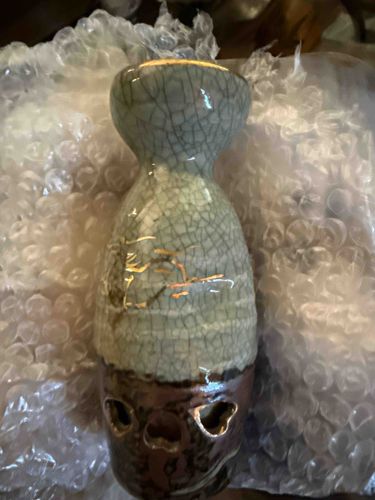
This is a ceramic sake bottle, known as a tokkuri in Japanese culture, designed for serving sake. The bottle features a distinctive two-toned appearance. The upper body is coated in a pale green, possibly celadon or light jade, crackle glaze, which exhibits a network of fine lines across its surface, a characteristic often indicative of an intentional firing process for aesthetic appeal. There are faint gold or light brown embossed decorative elements on the upper half, which appear to depict stylized natural motifs, possibly branches or abstract symbols, adding a subtle luxurious touch. The bottle has a narrow neck that flares out slightly at the rim. The lower portion of the bottle transitions to a darker, possibly reddish-brown or metallic bronze glaze, which has a richer, more iridescent quality. This lower section is adorned with at least three symmetrically placed, cutout or deeply embossed designs that resemble hearts or stylized floral shapes, with the inner edges appearing to be highlighted in a lighter, possibly gold or cream color. The craftsmanship suggests it is a handcrafted item, with the crackle glaze requiring specific temperature control during firing. The overall condition appears good, with no visible major chips or cracks, though the image quality makes it difficult to assess minor imperfections or wear. The intentional crackle and rustic aesthetic suggest a traditional Japanese pottery style, likely 20th century or contemporary.
AI Appraisal Report
Based on my visual examination of the provided image, this Japanese ceramic sake bottle, or tokkuri, presents as a well-crafted piece. The two-toned glazing, featuring a pale green crackle glaze on the upper body and a darker, possibly reddish-brown or metallic bronze lower section, is aesthetically pleasing. The subtle embossed decorative elements on the upper half and the cutout or deeply embossed heart/floral shapes on the lower half suggest careful artisanal work. The condition appears good from the photo, with no obvious chips or major cracks, which is a positive factor. The intentional crackle and overall rustic aesthetic align with traditional Japanese pottery.
In terms of market conditions, similar handcrafted tokkuri of contemporary or 20th-century origin, especially those with distinctive glazes and decorative elements, typically fetch modest prices. While unique, this item does not appear to exhibit traits that would suggest significant rarity or attribution to a highly renowned potter, which would dramatically increase its value. Factors impacting value positively include its appealing design and apparent good condition. However, without a physical inspection, verifying the precise glaze quality, the true depth of the embossing, and the absence of minor flaws (e.g., hairline cracks, glaze skips, or repairs) is impossible. Full authentication of age, origin, and specific maker, if any, would require in-person examination, potentially including tactile assessment, detailed photography from all angles, and examination of any maker's marks on the base. Provenance documentation, such as purchase records or exhibition history, would also be invaluable for confirming authenticity and origin precisely.