These notes were written by the person who submitted this item. Appraiser.AI has not verified them, and the AI's identification and estimate may rely on them.
AI Estimated Value
Not an official valuation
$30-60
AI estimate as of July 22, 2025 · verify with a professional before acting
AI-Generated · Verify before acting
Everything on this page is generated by AI for informational purposes only. AI can make mistakes — the AI may misidentify items or misattribute them (artist, maker, brand, designer, origin, era). This is not an official valuation and should not be used for insurance, sale, tax, estate, legal, or lending purposes — or any decision requiring a certified appraisal. It is not an authoritative claim about any person, brand, or rights holder — do not share or rely on it as a factual statement about a third party. Always consult qualified professionals before making financial decisions.
This analysis also relies on unverified notes provided by the user, which may be incomplete or inaccurate and could affect the result.
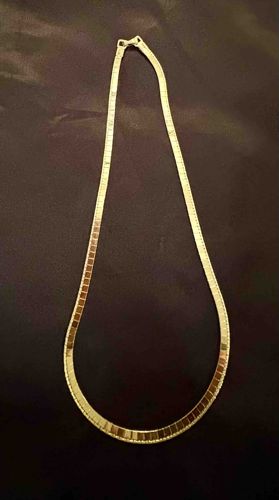
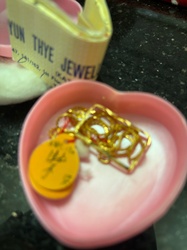
The item is a Monet gold-tone necklace, specifically identified as a 'snake chain' or 'herringbone chain' style costume jewelry piece. It features a bright, reflective gold-tone finish, which appears to be a plating over a base metal. The chain is composed of a series of tightly linked, flat, chevron-shaped segments that create a smooth, fluid surface, giving it its characteristic serpentine appearance. The overall length of the necklace appears to be suitable for wearing as a choker or a short princess length, likely around 16-18 inches, consistent with the '18 k' annotation in the context (though this likely refers to the length, not gold karatage). While the context mentions 'Monet silver tone necklace 18 k', the visual evidence clearly shows a gold tone, suggesting the silver tone might be a reference to another piece or a misunderstanding. The clasp mechanism is visible at one end, appearing to be a simple spring ring clasp, typical for costume jewelry of this era. The necklace exhibits a slight curvature consistent with having been worn or stored. There are no obvious signs of significant damage such as kinks, dents, or scratches visible from the provided images, indicating it is in good to very good pre-owned condition. The craftsmanship suggests mass production, as is common with Monet jewelry, known for its quality costume pieces. Monet jewelry typically dates from the mid-20th century onwards, with this style being particularly popular from the 1970s to 1990s.
AI Appraisal Report
Based on my visual examination of the provided image and the description, I confidently assess this Monet necklace to be a gold-tone herringbone/snake chain. Despite the owner's note of "silver tone," the visual evidence is unequivocally gold. The "18 k" likely refers to the length, approximately 18 inches, a common dimension for such chains, rather than gold karatage, which would be inconsistent with costume jewelry.
The condition appears to be very good pre-owned, showing typical signs of gentle wear but no obvious kinks, dents, or significant scratches, which are common issues with this style of chain. Monet is a well-regarded name in vintage costume jewelry, known for its durable plating and classic designs. This particular herringbone style was extremely popular from the 1970s through the 1990s.
From a market perspective, vintage Monet costume jewelry is generally accessible and collectible. Demand for these pieces is steady among collectors of vintage accessories, often driven by nostalgia or a desire for classic, quality-made costume pieces. However, common styles like this snake chain, while attractive, are not rare. Rarity typically comes into play with more elaborate or unique Monet designs, or pieces set with specific stones.
Factors significantly impacting value include the brand recognition (Monet is a plus), the good condition, and the timeless style. However, as it is costume jewelry and a relatively common design, its primary value is aesthetic and collectible, not intrinsic material value.
Limitations for full authentication based on images alone include the inability to inspect the hallmark directly (though Monet's is generally distinct), feel the weight, or assess the integrity of the clasp mechanism up close. While it strongly appears authentic Monet, a physical inspection would confirm the maker's mark, assess the overall craftsmanship and potential minor flaws not visible in images, and thoroughly test the clasp functionality and plating durability. Provenance documentation, while helpful, is rarely available for common costume jewelry.