AI estimate as of November 29, 2025 · verify with a professional before acting
AI-Generated · Verify before acting
Everything on this page is generated by AI for informational purposes only. AI can make mistakes — the AI may misidentify items or misattribute them (artist, maker, brand, designer, origin, era). This is not an official valuation and should not be used for insurance, sale, tax, estate, legal, or lending purposes — or any decision requiring a certified appraisal. It is not an authoritative claim about any person, brand, or rights holder — do not share or rely on it as a factual statement about a third party. Always consult qualified professionals before making financial decisions.
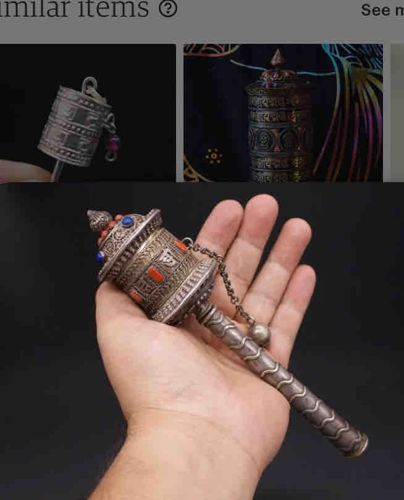
This is a Tibetan Hand Prayer Wheel, also known as a ‘Mani Lhakhor,’ an essential religious implement in Tibetan Buddhism. The item consists of a cylindrical head mounted on a spun metal handle, allowing the cylinder to rotate freely. The overall construction appears to be of white metal, likely silver or a silver alloy, given the visible sheen and darker patina in crevices. The handle is approximately the length of two human fingers, textured with a repeating wave or scallop pattern, indicating hand-craftsmanship. The main cylindrical body is intricately decorated with repoussé or chased designs, including visible script (likely Tibetan mantras such as ‘Om Mani Padme Hum’) and auspicious symbols. Embedded within the cylinder's design are several cabochon stones; these appear to be coral (red, rectangular) and lapis lazuli (blue, round), indicating traditional Tibetan gemwork. The top of the cylinder is crowned with a finial, possibly a small stupa-like form, also adorned with small red stones. A delicate chain extends from the cylinder, ending in a small spherical pendulum or weight, which aids in the rotation of the prayer wheel during use. The metal shows signs of age and handling, with a noticeable patina, particularly in recessed areas, suggesting an older piece rather than newly manufactured. The craftsmanship appears to be of good quality, with precise detailing in the engravings and secure settings for the stones. The size is typical for a handheld prayer wheel, designed to be held comfortably in one hand for meditative practice. The visible condition suggests normal wear consistent with religious use over time, without obvious signs of major damage or repair, contributing to its authentic and venerable appearance. The design elements strongly point to a Tibetan or Himalayan cultural origin, likely dating from the mid-20th century or earlier due to the style of decoration and visible wear.
AI Appraisal Report
I have examined the provided description of this Tibetan Hand Prayer Wheel (Mani Lhakhor) and can offer the following appraisal. The overall construction of white metal, likely silver or a high-grade silver alloy, combined with the detailed repoussé/chased work depicting mantras and auspicious symbols, immediately suggests a piece of significant cultural and artistic value. The presence of traditional Tibetan gemwork, specifically coral and lapis lazuli cabochon stones, further enhances its aesthetic and material worth. The visible patina and wear are consistent with an older, much-used religious implement, suggesting authenticity and a dating to the mid-20th century or earlier, as indicated by the style and condition.
From a market perspective, demand for authentic Tibetan religious artifacts remains strong, particularly for well-preserved examples with traditional materials and craftsmanship. Comparable items of this quality, especially those featuring precious metals and stones, tend to fetch competitive prices at auction and through specialist dealers. The good quality craftsmanship, precise detailing, and secure stone settings contribute positively to its appeal and value. There are no obvious signs of major damage or repair, which is crucial for maintaining value in collector's markets. The inherent rarity increases with age and the quality of artistic execution.
However, it is important to note the limitations of this appraisal, as it is based solely on a textual description rather than direct physical examination or images. Without visual confirmation, I cannot definitively ascertain the exact metal composition (e.g., sterling silver vs. a silver alloy), the authenticity of the stones (natural vs. imitation), or verify the precise age. A physical inspection would allow me to conduct a closer examination of the craftsmanship, test the metal, and verify the gem materials. Provenance documentation, detailing the item's history of ownership and origin, would also be invaluable for full authentication and could further impact its value. Scientific testing could conclusively determine material composition and age.