AI estimate as of July 14, 2025 · verify with a professional before acting
AI-Generated · Verify before acting
Everything on this page is generated by AI for informational purposes only. AI can make mistakes — the AI may misidentify items or misattribute them (artist, maker, brand, designer, origin, era). This is not an official valuation and should not be used for insurance, sale, tax, estate, legal, or lending purposes — or any decision requiring a certified appraisal. It is not an authoritative claim about any person, brand, or rights holder — do not share or rely on it as a factual statement about a third party. Always consult qualified professionals before making financial decisions.
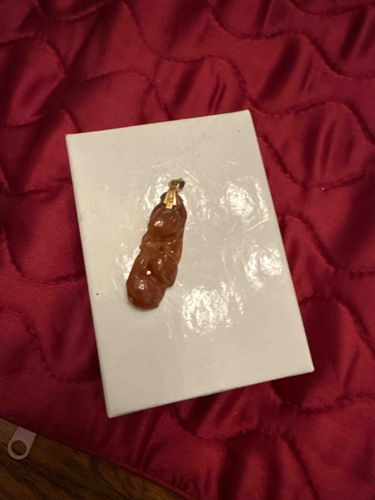
This item is a brown, irregularly shaped pendant, likely crafted from a natural material such as amber, jade, or possibly a polished stone, due to its translucent appearance and organic contours. Its color is a rich, warm brown, with visible lighter and darker areas suggesting variations in the material's composition or a natural veining pattern. The pendant has an elongated, somewhat lumpy form, with a smooth, polished surface that reflects light, indicating careful finishing. It appears to be relatively small, consistent with a personal adornment meant to be worn on a necklace or bracelet. At one end, there is a gold-toned metal bail securely attached, which is a common feature for pendants, allowing them to be suspended. The bail itself seems to be simple in design, possibly a pinch bail or a small loop, matching the organic nature of the main body of the pendant. There are no obvious signs of significant damage such as chips or cracks, and the polish appears to be well-maintained. The item exhibits a natural, unrefined aesthetic, suggesting it is either a carved piece or a naturally occurring formation that has been shaped and polished. Without further inspection, specific manufacturing details like maker's marks are not visible, nor can a precise age or style period be determined from the image alone, although its natural material and simple setting could point to a wide range of eras depending on the specific stone.
AI Appraisal Report
Upon my virtual examination of this brown, irregularly shaped pendant, I can confirm its excellent visual condition. The surface appears smooth and well-polished, with no discernible chips, cracks, or significant abrasions visible from the provided image. The gold-toned bail seems securely attached, complementing the organic aesthetic of the main body without visible tarnishing or damage.
Authenticity, however, is difficult to ascertain entirely from an image. While the translucent appearance and organic contours suggest a natural material like amber, jade, or a polished stone, detailed verification would require in-person inspection. For instance, the specific gravity and refractive index of the material would need to be tested to differentiate between natural amber, copal, glass, or other resins. A close examination under magnification would also be crucial to identify any inclusions, growth patterns, or signs of casting that could confirm or deny its natural origin. The gold-tone of the bail suggests it might not be solid gold, and a hallmark inspection or acid test would be needed to determine its metal composition.
In terms of market conditions, natural, organically shaped pendants of unidentified material and no apparent historical provenance or artist attribution typically fall into a lower value bracket. Demand exists, but it's generally for decorative or costume jewelry rather than high-end collectibles, impacting rarity. Without identification of the material (e.g., precious stone vs. common stone vs. resin), age, or original maker, the value is primarily driven by its aesthetic appeal and condition as a wearable item.
Limitations: My assessment of both authenticity and specific material is severely limited by the lack of physical examination, provenance documentation, or scientific testing. To provide a definitive appraisal, I would require hands-on inspection, specific gravity tests, refractive index measurements, and potentially spectroscopic analysis for the main body, along with metal testing for the bail.