AI estimate as of October 12, 2025 · verify with a professional before acting
AI-Generated · Verify before acting
Everything on this page is generated by AI for informational purposes only. AI can make mistakes — the AI may misidentify items or misattribute them (artist, maker, brand, designer, origin, era). This is not an official valuation and should not be used for insurance, sale, tax, estate, legal, or lending purposes — or any decision requiring a certified appraisal. It is not an authoritative claim about any person, brand, or rights holder — do not share or rely on it as a factual statement about a third party. Always consult qualified professionals before making financial decisions.
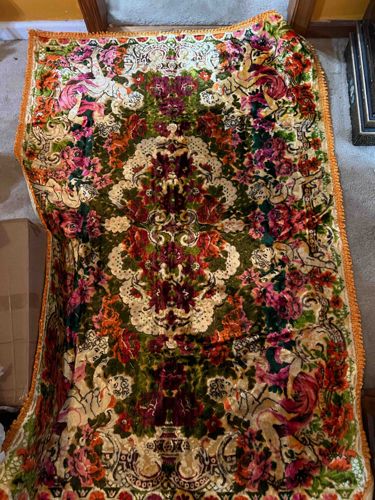
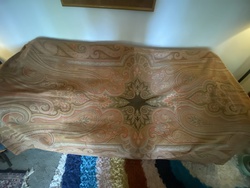
This is a vintage tapestry blanket, likely from the mid-20th century, characterized by its vibrant floral and figural design. The blanket appears to be made from a velvet or plush fabric, potentially a cut pile weave, which gives it a rich texture and depth, especially noticeable in the varying heights of the pile that create a slightly embossed effect. The color palette is vivid and complex, dominated by shades of deep red, fuchsia, pink, and orange-pink for the flowers, interspersed with olive green and darker green leaves and foliage against a cream or light tan background. A central medallion motif, typical of traditional tapestry and rug designs, features intricate scrollwork and floral elements. Surrounding this are additional floral clusters and, notably, figural elements depicting cherubic or putti-like figures, some seemingly interacting with the floral garlands. The overall style suggests a rococo or baroque influence, reinterpreted in a more popular, possibly mass-produced, textile. The edges of the blanket are finished with a distinct, possibly hand-stitched, orange or gold-colored trim, which has a braided or crocheted appearance, adding to its decorative appeal. Visible condition issues include some general wear consistent with age, such as slight flattening of the pile in certain areas and possibly minor discoloration or fading, though the colors largely remain rich. There are no obvious tears or significant damage, and the craftsmanship appears to be good for a decorative textile of this type. The tactile quality of the velvet-like material would have made this a comfortable and luxurious item for warmth or as a decorative throw.
AI Appraisal Report
Upon visual examination of this vintage floral and figural tapestry blanket, I assess it to be a charming decorative textile, likely dating from the mid-20th century. The 'velvet or plush fabric' with a 'cut pile weave' indicates good tactile quality and visual depth, consistent with the period and type. The 'vivid and complex' color palette and the 'rococo or baroque influence' with cherubic figures contribute to its aesthetic appeal. The 'orange or gold-colored trim' adds a nice finishing touch.
Condition-wise, the description notes 'general wear consistent with age, such as slight flattening of the pile' and 'possibly minor discoloration or fading,' which is expected for such an item. Crucially, the absence of 'obvious tears or significant damage' is a positive factor, suggesting it has been reasonably well-preserved. This limits, however, its desirability for premium collectors, as condition is paramount in textile valuations.
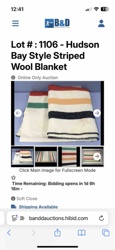
In terms of market conditions, items of this nature are generally found in the lower-to-mid range of vintage decor. While aesthetically pleasing, they are not exceedingly rare, and the 'mass-produced' aspect mentioned in the description suggests a broader availability. Comparables typically sell in antique malls or online vintage marketplaces for modest sums, reflecting their decorative rather than fine-art status. Demand is steady for appealing vintage textiles, but rarely reaches exceptional levels unless associated with a prominent maker or highly desirable artistic movement.
Factors impacting value include its good, albeit aged, condition, and its attractive, detailed design. However, the lack of a known maker or unique provenance limits its top-tier potential. The 'mass-produced' connotation, though suggesting wider availability, also points to a more modest valuation.
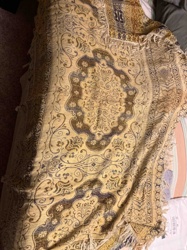
Authenticity verification from images alone has limitations. While the style and described characteristics align with a mid-20th-century decorative tapestry, a full physical inspection would be needed to confirm the exact fiber composition, weave technique, true extent of wear and fading, and to check for hidden repairs or manufacturing marks. Microscopic analysis of fibers or dyes could definitively date it, and a review of any attached labels or provenance documentation would be essential for confirming origin or maker.