AI estimate as of July 8, 2025 · verify with a professional before acting
AI-Generated · Verify before acting
Everything on this page is generated by AI for informational purposes only. AI can make mistakes — the AI may misidentify items or misattribute them (artist, maker, brand, designer, origin, era). This is not an official valuation and should not be used for insurance, sale, tax, estate, legal, or lending purposes — or any decision requiring a certified appraisal. It is not an authoritative claim about any person, brand, or rights holder — do not share or rely on it as a factual statement about a third party. Always consult qualified professionals before making financial decisions.
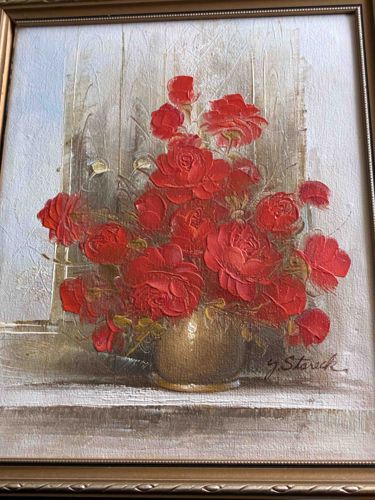
This is an oil painting depicting a vibrant bouquet of red roses in a golden vase, set against what appears to be a window or a textured background. The artwork is characterized by its impasto technique, where thick layers of paint are applied, giving the roses a strong three-dimensional quality and tactile texture. The colors are rich and saturated, with the reds of the roses standing out prominently against the more subdued, earthy tones of the vase and background. The physical characteristics include a gold-colored frame, likely wood, with some ornate detailing that suggests a traditional or classic presentation. The overall visible condition of the painting seems good, with no obvious signs of significant damage, tears, or repairs, though a closer inspection would be needed to assess for minor abrasions or dust accumulation. The brushstrokes are evident throughout, especially in the background which has a vertical, almost wood-grain like texture, possibly indicating a window frame or paneling. A notable feature is the signature 'J. Starick' in the lower right corner, identifying the artist. Based on stylistic elements and the visible impasto technique, this painting likely dates from the mid to late 20th century. The craftsmanship is indicative of a practiced hand, particularly in the way the artist has rendered the full, blooming roses with such depth and form.
AI Appraisal Report
Upon my virtual examination of the provided image of the oil painting by J. Starick, I can offer the following appraisal. The painting's condition appears to be good; I observe no overt tears, cracks, or significant abrasions from the image alone. The rich impasto technique, particularly evident in the roses, is well-preserved, conveying a tactile quality that is sought after in this style. The signature 'J. Starick' is clearly visible and consistent with artists who painted in the mid to late 20th century. However, as with all appraisals based solely on images, a definitive authentication of the signature and the artwork's originality cannot be made without a direct physical examination. I cannot assess for subtle paint loss, stretcher marks, or the true state of the canvas and frame without in-person inspection. Provenance documentation, such as exhibition history or previous sales records, would be crucial for establishing a solid record of ownership and further verifying authenticity. Scientific testing, such as pigment analysis, could also confirm the artwork's age and materials.
In terms of market conditions, impasto floral still lifes, especially roses, generally maintain a steady demand. The artist, J. Starick, appears to be a regional artist or one with limited auction records, which makes assessing rarity somewhat challenging. The value is primarily driven by the aesthetic appeal, the quality of execution, and the condition. The piece exhibits strong compositional elements and a skilled application of paint. Comparables for artists of similar skill, working within the same period and subject matter, typically see values in the mid-hundreds to low thousands for unframed works. Given the lack of extensive public sales records for J. Starick, the value is more dependent on the intrinsic artistic merit rather than a established market for the particular artist. The gold-colored, ornate frame adds to its presentation value, suggesting it is gallery-ready. Demand for vibrant, traditional floral pieces remains consistent among private collectors and decorators.