These notes were written by the person who submitted this item. Appraiser.AI has not verified them, and the AI's identification and estimate may rely on them.
AI Estimated Value
Not an official valuation
$100-150
AI estimate as of August 2, 2025 · verify with a professional before acting
AI-Generated · Verify before acting
Everything on this page is generated by AI for informational purposes only. AI can make mistakes — the AI may misidentify items or misattribute them (artist, maker, brand, designer, origin, era). This is not an official valuation and should not be used for insurance, sale, tax, estate, legal, or lending purposes — or any decision requiring a certified appraisal. It is not an authoritative claim about any person, brand, or rights holder — do not share or rely on it as a factual statement about a third party. Always consult qualified professionals before making financial decisions.
This analysis also relies on unverified notes provided by the user, which may be incomplete or inaccurate and could affect the result.
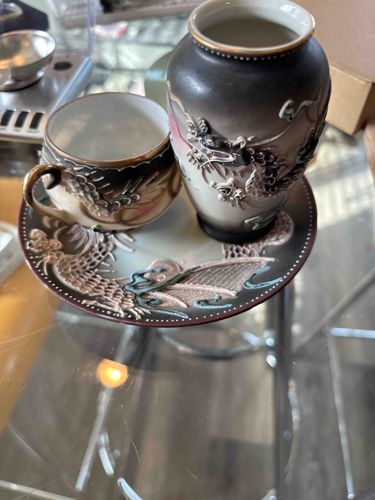
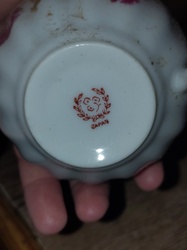
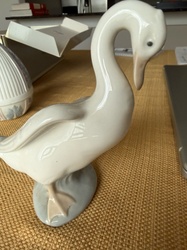
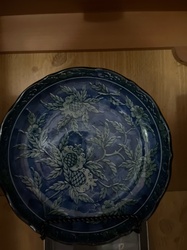
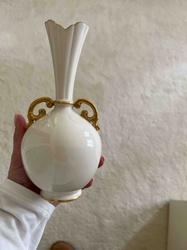
This is a Japanese ceramic tea set component, comprising a cup, a vase, and a saucer, all featuring highly detailed, hand-painted and sculpted dragon motifs. The primary material appears to be a type of porcelain or finely-glazed earthenware, given its smooth, lustrous surface and delicate construction. The predominant colors are dark brown or black, transitioning to a lighter beige or off-white, with significant use of metallic gold on the rim of the cup and vase, and often as highlights on parts of the dragon's scales. The dragons themselves are rendered in high relief, creating a tactile texture that adds to their imposing presence. Their bodies are coiled and intertwined around the pieces, with intricate scales, claws, and facial features clearly visible. Notably, there are subtle hints of pink on the vase, possibly indicating clouds or mist, which contrasts with the darker background and provides depth to the scene. The saucer, while not fully visible, clearly displays a large, sprawling dragon that appears to cover most of its surface, with similar raised details and gold accents. Small white dots form a decorative border around the rim of the saucer, adding a refined touch. The craftsmanship is evident in the precise modeling of the dragons and the delicate application of the glazes and paints. There are no obvious signs of chips or cracks from the visible angles, suggesting good preservation, though the general patina and potential, minor wear on the gold accents might indicate age. The pieces likely date from the late 19th to early 20th century, a period known for highly decorative and export-oriented Japanese ceramics, often referred to as Satsuma ware or a similar style, characterized by such intricate enamel work and raised decoration. The overall quality suggests a piece intended for display as much as for use, highlighting the artistic skill involved in its creation.
AI Appraisal Report
Upon examining the images of the Japanese Dragon Motif Ceramic Tea Set Components, my assessment points to a collectible set, likely of Satsuma or a similar style, dating from the Meiji (1868-1912) or Taisho (1912-1926) period. The high-relief, hand-sculpted dragon, known as 'moriage,' and the detailed hand-painting with gilt accents are characteristic of export ware from this era. The craftsmanship appears to be of good quality, with intricate modeling of the dragon's scales and features. The pieces seem to be in good to very good condition, with no visible chips or cracks, although some minor wear to the gilding is expected with age and would be consistent with an authentic period piece.
The current market for this type of Japanese decorative ceramic is stable, with consistent demand from collectors. Similar Moriage dragonware sets or individual pieces are frequently available, which tempers the value. However, the completeness of this three-piece set (cup, saucer, and a matching vase) adds to its appeal and value. Rarity is moderate; while the theme is common, the quality and condition of this particular set appear above average.
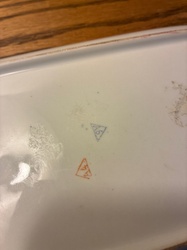
The primary factor influencing value here is the quality of the moriage application and the overall artistic execution. A higher level of detail and preservation commands a better price. It is important to note that this appraisal is based solely on images. Full authentication would require a physical examination to identify any maker's marks on the base, which are crucial for attribution and precise dating. Additionally, a close inspection under magnification would be necessary to confirm the absence of hairline cracks or repairs and to verify the age of the materials.