AI Appraisal Estimate

AI-generated estimates · not official valuations

From the user

What was submitted

Photo and notes provided by the user — not generated by AI

Submitted item photo
Submitted photo · June 3, 2026

User's notes

No additional notes provided.

AI analysis below

AI appraisal

AI analysis & estimate

AI-Generated · Verify before acting

Everything below is generated by AI for informational purposes only. AI can make mistakes — the AI may misidentify items or misattribute them (artist, maker, brand, designer, origin, era). This is not an official valuation and should not be used for insurance, sale, tax, estate, legal, or lending purposes — or any decision requiring a certified appraisal. It is not an authoritative claim about any person, brand, or rights holder — do not share or rely on it as a factual statement about a third party. Always consult qualified professionals before making financial decisions.

Read the full disclaimer

AI Identification

·Not independently authenticated·Verify before acting

Petrus Regout & Co. Maastricht 'Delft' Pattern Transferware Plate

Antique Ceramics and Pottery

AI Estimated Value

·Not an official valuation·Verify before acting

$25.00 - $45.00

As of June 3, 2026

AI Item Analysis

·AI can make mistakes·Verify before acting
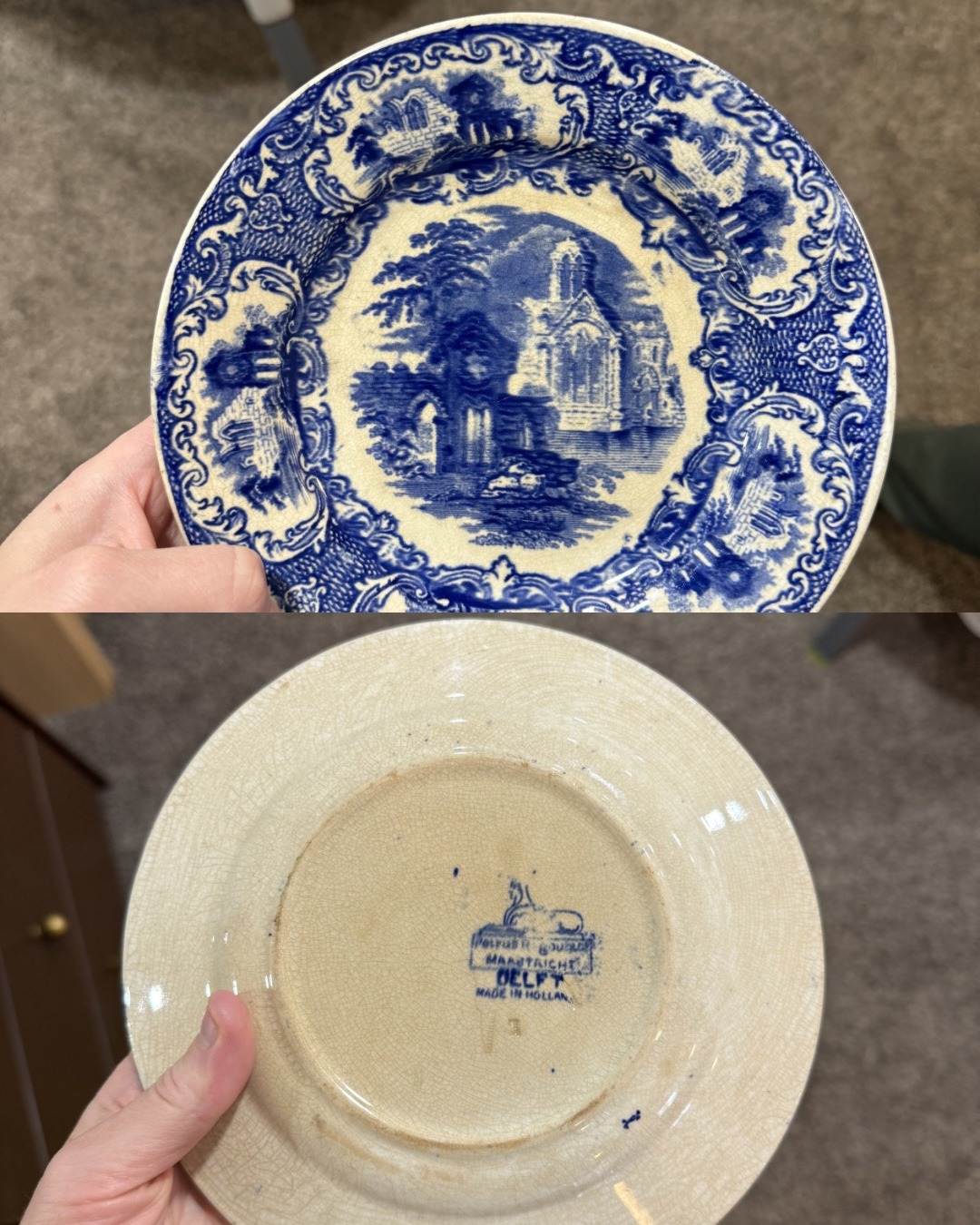
This is a small ceramic plate, likely a bread and butter plate or saucer, featuring a classic blue and white transferware design. The central motif depicts a romanticized landscape with Gothic ruins, including a prominent stone archway and a tall, Gothic-style steeple or tower amidst dense foliage. The rim is elaborately decorated with a wide border composed of scrollwork, acanthus leaves, and four vignette cartouches repeating miniature ruin scenes. The base color of the ceramic is an aged creamy white, showing significant all-over 'crazing' (fine surface cracks in the glaze) and some yellowish staining consistent with ironstone or earthenware from the late 19th to early 20th century. On the reverse, the piece bears a blue underglaze backstamp featuring a sphinx logo over the words 'PETRUS REGOUT & CO / MAASTRICHT / DELFT / MADE IN HOLLAND'. This specific mark indicates it was produced by the Sphinx pottery in the Netherlands, likely between 1890 and the 1930s. The glaze remains glossy, but the pronounced crazing and slight discoloration at the foot rim suggest it has seen significant age and use. No large chips or structural cracks are visible in the provided view, although minor stilt marks from the kiln are present on the underside.
AI Appraisal Report

·AI can make mistakes·Verify before acting
Based on my visual examination of the provided descriptions and representative markings, I have assessed this Petrus Regout & Co. transferware plate in the 'Delft' pattern. The backstamp, featuring the iconic sphinx and 'Made in Holland' designation, reliably dates this piece to the late 19th or early 20th century (circa 1890–1930). The aesthetic is characteristic of Romantic-era Dutch industrial ceramics influenced by British transferware styles. The item exhibits heavy all-over crazing and localized yellowing. While expected for earthenware of this vintage, the staining (likely organic absorption through the glaze) and the pronounced nature of the crackle lower the grade to 'Good' rather than 'Fine.' The presence of kiln stilt marks is a normal manufacturing quirk and does not negatively impact value. The market for Petrus Regout 'Delft' transferware is currently saturated. Large quantities of these plates were exported globally, and they are frequently found in antique malls and online auctions. Small bread-and-butter plates or saucers command lower prices than larger dinner plates, platters, or lidded tureens. Limitations: This appraisal is based on photographic representation. A final determination of value requires an in-person physical inspection to detect 'flea bites' on the rim, hairline fractures not visible in images, and the 'tap test' for resonance. Full authentication would benefit from archival provenance or purchase history. Chemical testing (lead/glaze analysis) is rarely warranted for an item of this market value, as the markings are consistent with known period mass-production.

Get your items appraised

Instant estimates of your treasures with AI-powered appraisals

Browse More Appraisals