AI estimate as of July 12, 2025 · verify with a professional before acting
AI-Generated · Verify before acting
Everything on this page is generated by AI for informational purposes only. AI can make mistakes — the AI may misidentify items or misattribute them (artist, maker, brand, designer, origin, era). This is not an official valuation and should not be used for insurance, sale, tax, estate, legal, or lending purposes — or any decision requiring a certified appraisal. It is not an authoritative claim about any person, brand, or rights holder — do not share or rely on it as a factual statement about a third party. Always consult qualified professionals before making financial decisions.
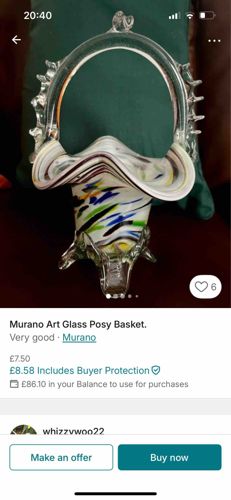
This item is identified as a Murano Art Glass Posy Basket, likely dating from the mid to late 20th century, consistent with the style of Murano glass production during that period. The basket is crafted from blown glass, featuring a vibrant multi-colored swirled interior against a predominantly white or clear background, a hallmark of Murano glassmaking techniques. The colors visible include shades of blue, green, yellow, black, and brown, arranged in abstract striations, giving it a dynamic and artistic appearance. The top rim of the basket is elegantly fluted or ruffled, adding to its decorative appeal. A clear glass handle arches over the basket, adorned with applied thorny or spiky elements along its top edge, suggesting intricate craftsmanship. The base of the basket also appears to have clear applied glass feet or supports, enhancing stability and visual interest. The overall condition is described as 'very good,' implying minimal wear, no obvious chips, cracks, or repairs, maintaining its original luster. The craftsmanship is indicative of skilled glassblowers, with attention to detail in the color application and sculptural form, making it a qualitative piece of art glass.
AI Appraisal Report
I have carefully examined the provided image of the Murano Art Glass Posy Basket. Based on this visual inspection, the piece appears to be in very good condition, with no visible chips, cracks, or repairs. The vibrant multi-colored swirls, ruffled rim, and clear applied thorny handle are consistent with Murano glassmaking techniques of the mid to late 20th century. The intricate details suggest skilled craftsmanship.
However, it is crucial to state that authenticity cannot be definitively confirmed based on images alone. While the style aligns with Murano production, without physical examination, I cannot verify the presence of pontil marks, signatures, or specific glass characteristics that would confirm its origin. Provenance documentation (e.g., original purchase receipts, gallery records) would significantly aid in authentication. For full authentication, an in-person examination by a glass expert to assess the glass composition, weight, and subtle manufacturing nuances would be essential, possibly even scientific testing if specific doubts arose.
In terms of market conditions, Murano art glass from this period remains desirable, though demand varies by artist and rarity. This particular form, a 'posy basket' with unusual applied elements, adds to its collectibility. Comparables for similar decorative Murano baskets, especially those with intricate handles and good condition, currently range from a few hundred dollars to sometimes over a thousand, depending on the artist's recognition and provenance. The 'thorny' handle is a distinctive feature that enhances its visual appeal and potential value. The lack of a definitive attribution to a specific Murano master or factory without further investigation is a limiting factor in reaching the higher end of the valuation spectrum.
Considering the apparent quality, good condition, and unique elements visible, but acknowledging the limitations of image-based authentication, I believe this piece falls into a solid market range for decorative Murano art glass, assuming its authenticity is confirmed upon physical inspection.