AI estimate as of July 30, 2025 · verify with a professional before acting
AI-Generated · Verify before acting
Everything on this page is generated by AI for informational purposes only. AI can make mistakes — the AI may misidentify items or misattribute them (artist, maker, brand, designer, origin, era). This is not an official valuation and should not be used for insurance, sale, tax, estate, legal, or lending purposes — or any decision requiring a certified appraisal. It is not an authoritative claim about any person, brand, or rights holder — do not share or rely on it as a factual statement about a third party. Always consult qualified professionals before making financial decisions.
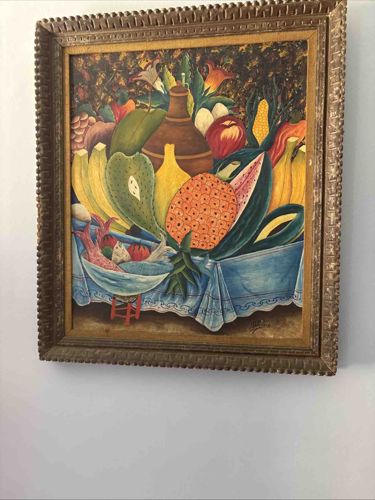
This is an oil painting or acrylic painting on canvas or board, depicting a vibrant still life composition of various tropical fruits and vegetables. The artwork is characterized by bold, somewhat flattened forms and a rich, earthy color palette. Dominant colors include shades of green, yellow, orange, and brown for the produce, set against a darker, mottled background of foliage or brush. Notable items in the composition include a large pineapple, bananas, what appears to be a prickly pear cactus pad, corn on the cob, a watermelon slice, and a large brown ceramic pot or jug. Many of the fruits are depicted with their leaves or stems, adding to the naturalistic feel despite the stylized rendering. The items are arranged on a blue tablecloth with a scalloped, lighter blue or white lace-like trim visible along the bottom edge, suggesting a domestic setting. A small, red, three-legged stool or stand is visible beneath the tablecloth on the left side, supporting a portion of the draped fabric. The brushwork appears somewhat loose and expressive, contributing to a folk art or naive art aesthetic. There is a visible signature in the lower right corner, though illegible from the image resolution. The painting is housed in a carved wooden frame with a rich, dark brown or gilt finish, featuring a repeating pattern of reeded or leaf-like molding which adds to its decorative appeal. The frame itself shows some signs of wear consistent with age, such as minor scratches or patina. The painting itself appears to be in good overall condition, with no immediately obvious signs of major damage or paint loss. The style suggests a mid-20th century to late 20th century origin, possibly Latin American given the subject matter and artistic style, which frequently embraces such vibrant, stylized depictions of local produce.
AI Appraisal Report
I have examined the provided image of the 'Tropical Still Life with Fruits and Pot,' which appears to be an oil or acrylic painting. The artwork is in good overall condition, showing no immediate signs of major damage or paint loss. The carved wooden frame exhibits minor wear consistent with its age, contributing to its decorative appeal.
Authenticity, based solely on the image, is difficult to confirm without a physical examination. The visible signature in the lower right corner, though illegible, suggests an artist. I would need to physically inspect the painting to confirm the medium, verify the signature against known exemplars, and assess the brushwork's consistency. Provenance documentation, such as exhibition history or previous ownership records, would be crucial for full authentication. Scientific testing, like pigment analysis, could further confirm the age and materials.
The style, characterized by flattened forms, an earthy color palette, and folk art aesthetic, points to a mid-to-late 20th-century origin, possibly Latin American. This genre often finds a consistent, albeit modest, demand in the secondary market. Comparable works by lesser-known or regional artists in a similar naive or folk art style typically sell in the low to mid-hundreds. Factors impacting value include the artist's recognition (if the signature can be attributed), the painting's dimensions (which cannot be determined from the image), and the overall artistic quality and subject appeal. The vibrant colors and tropical theme are generally appealing. Rare considerations are limited given the commonality of still life as a subject, though the specific combination of elements and stylistic execution adds uniqueness. Without an identifiable artist or remarkable provenance, the value is primarily decorative.