AI estimate as of October 2, 2025 · verify with a professional before acting
AI-Generated · Verify before acting
Everything on this page is generated by AI for informational purposes only. AI can make mistakes — the AI may misidentify items or misattribute them (artist, maker, brand, designer, origin, era). This is not an official valuation and should not be used for insurance, sale, tax, estate, legal, or lending purposes — or any decision requiring a certified appraisal. It is not an authoritative claim about any person, brand, or rights holder — do not share or rely on it as a factual statement about a third party. Always consult qualified professionals before making financial decisions.
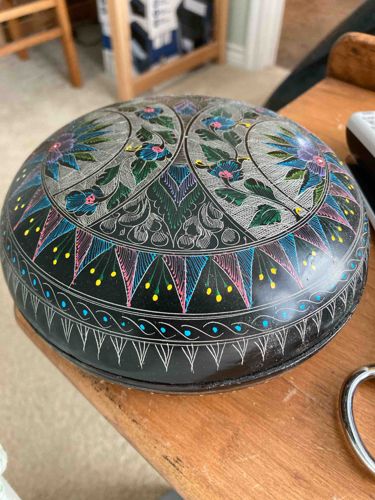
This is a circular, lidded box, likely crafted from soapstone, given its dark, matte appearance and the nature of the carving. The base color of the box is a deep black or dark charcoal. The exterior surface is extensively carved with intricate patterns and then highlighted with colorful paints. The lid features a central design that appears to be two stylized floral motifs, possibly daisies or similar multi-petaled flowers, arranged symmetrically and interconnected by organic, flowing lines. These floral elements are painted in shades of blue, purple, and green, with some lighter blue and pink accents within the petals and leaves. The background within these carved areas is textured with fine, parallel lines creating a sense of depth and contrast against the smooth black uncarved portions. Around the central motifs, smaller floral or leaf-like elements are depicted, again with a textured carved background. The vertical sides of the box are adorned with a repeating pattern of triangular or jagged shapes in vibrant pink, blue, and green, often accented with small yellow circular dots giving them a whimsical, almost 'drip' like appearance. Below this, there's a band of white carved 'S' shapes or interlocking loops, interspersed with small light blue dots. The bottom edge of the box features a further band of white 'V' shaped carvings. The craftsmanship suggests hand-carving and painting, indicative of traditional folk art or artisan work. The overall condition appears good with minor surface wear visible, particularly around the edges and bottom rim, which could be typical of an item handled frequently. There are no obvious chips, cracks, or significant paint loss from the visible portions, although a close inspection of all angles would be needed to confirm this fully. The carving quality is detailed and precise, showcasing a skilled hand. The style points to a potential origin in a region known for soapstone carving, possibly Africa or parts of Asia. The general aesthetic suggests an item from the mid to late 20th century.
AI Appraisal Report
This Carved and Painted Soapstone Lidded Box is a charming example of decorative folk art. Based on my visual examination, the condition appears good, with only minor surface wear consistent with age and handling, particularly around the edges, but no obvious chips, cracks, or significant paint loss are visible in the provided image. The craftsmanship, with its detailed carving and vibrant hand-painted accents, indicates an authentic artisan piece, likely from the mid to late 20th century. The style suggests a potential origin from regions known for soapstone carving, such as Africa or parts of Asia.
In terms of market conditions, items of this nature are generally found in the decorative arts sector, often appealing to collectors of ethnic or global folk art. Comparables in the market for similar carved and painted soapstone boxes, typically in good condition, range in price depending on the intricacy of the carving, size, and specific regional origin. Demand for such pieces is moderate, driven by individual aesthetic preferences rather than high investment potential. They are not particularly rare, though the specific artistic patterns can make individual pieces unique.
Factors impacting value include the quality and intricacy of the carving and painting, which are notable here, and the overall condition. The lack of specific provenance or artist attribution limits its upper market value. To fully authenticate its origin and period, an in-person examination would be beneficial to assess the exact type of soapstone, the quality of the paint, and the carving tools used. Documentation, such as a bill of sale or expert opinion from a regional specialist, would also enhance its value and confirm its authenticity with greater certainty.