AI Appraisal Estimate

AI-generated estimates · not official valuations

From the user

What was submitted

Photo and notes provided by the user — not generated by AI

Submitted item photo
Submitted photo · June 4, 2026

User's notes

No additional notes provided.

AI analysis below

AI appraisal

AI analysis & estimate

AI-Generated · Verify before acting

Everything below is generated by AI for informational purposes only. AI can make mistakes — the AI may misidentify items or misattribute them (artist, maker, brand, designer, origin, era). This is not an official valuation and should not be used for insurance, sale, tax, estate, legal, or lending purposes — or any decision requiring a certified appraisal. It is not an authoritative claim about any person, brand, or rights holder — do not share or rely on it as a factual statement about a third party. Always consult qualified professionals before making financial decisions.

Read the full disclaimer

AI Identification

·Not independently authenticated·Verify before acting

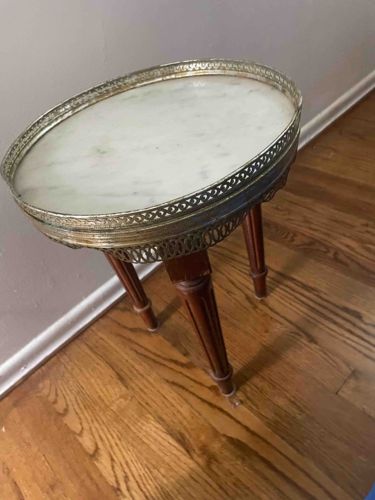
Oval Marble and Brass Occasional Table

Furniture

AI Estimated Value

·Not an official valuation·Verify before acting

$350-550

As of June 4, 2026

AI Item Analysis

·AI can make mistakes·Verify before acting
This is an elegant oval-shaped occasional or side table, likely designed as a plant stand or drinks table. The table features a solid white marble top with subtle grey veining, characteristic of natural stone. The marble appears polished but shows some minor discoloration or possible staining in areas, particularly towards what would be the top right in the primary image. The top is securely set within a highly ornate brass or brass-plated metal gallery rail, which forms the perimeter. This rail exhibits intricate openwork designs; the outermost band features a repetitive lattice or scroll pattern, while the inner band appears to have a series of connected circles or ovular shapes. The brass has a warm, aged patina, suggesting it has not been recently polished, which adds to its antique appeal. Below the tray, three slender, turned wooden legs provide support. The legs appear to be made of a dark-stained hardwood, possibly mahogany or a similar rich-toned wood, and feature subtle decorative turning, including ring elements near the top and bottom. The overall style suggests a mid-20th-century French Provincial or neoclassical influence. There are visible signs of age and use, including the aforementioned discoloration on the marble and expected wear on the metal and wood, consistent with an item of its apparent age, but no obvious major damage like cracks or breaks are discernible from the image. The craftsmanship appears to be of good quality, particularly in the detailed metalwork of the gallery.
AI Appraisal Report

·AI can make mistakes·Verify before acting
Upon visual examination of the images, this oval occasional table presents as a fine example of mid-20th-century decorative furniture, likely of French origin, blending neoclassical and Louis XVI revival styles. The piece features a white marble top with grey veining, set within an ornate, pierced brass gallery. The base consists of three turned and ebonized or dark-stained wooden legs. The overall condition appears to be good for its age, showing a desirable, mellow patina on the brass and typical signs of use, including minor surface discoloration on the marble top. The craftsmanship, particularly the detailed openwork of the brass gallery, is of good quality. Market analysis for similar mid-century French-style bouillotte or side tables shows a consistent demand. Comparable pieces from this era, featuring marble and brass, typically sell in the range of $300 to $600 at auction or through vintage retailers, depending on specific maker, condition, and provenance. The visible wear, while not major, slightly tempers the value from the higher end of the market. A significant limitation of this appraisal is that it is based solely on images. A full authentication would require in-person examination to confirm the materials—solid brass versus plating—and to identify any maker's marks or stamps, which are crucial for attribution. The nature of the wood and the construction method of the joinery would also need to be physically inspected. Without provenance documentation or a confirmed maker, the value remains that of a well-made decorative piece rather than a signed designer item.

Get your items appraised

Instant estimates of your treasures with AI-powered appraisals

Browse More Appraisals