AI estimate as of August 9, 2025 · verify with a professional before acting
AI-Generated · Verify before acting
Everything on this page is generated by AI for informational purposes only. AI can make mistakes — the AI may misidentify items or misattribute them (artist, maker, brand, designer, origin, era). This is not an official valuation and should not be used for insurance, sale, tax, estate, legal, or lending purposes — or any decision requiring a certified appraisal. It is not an authoritative claim about any person, brand, or rights holder — do not share or rely on it as a factual statement about a third party. Always consult qualified professionals before making financial decisions.
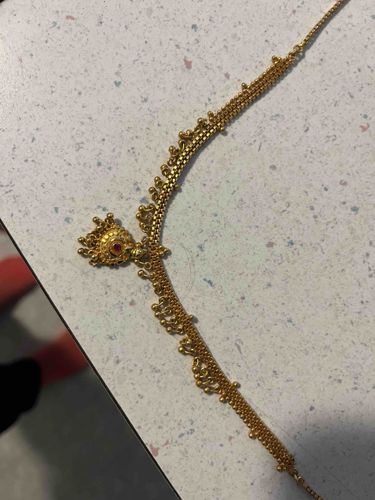
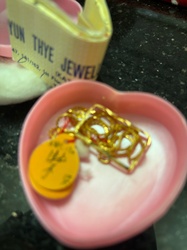
This exquisite piece appears to be a traditional Indian gold necklace, possibly an 'Ottiyanam' (waist belt) or a heavy choker-style necklace, given its design. It is crafted from a rich, golden-hued metal, likely high-carat gold, a common material for such intricate jewelry in South Asian cultures. The primary design features a finely woven or braided chain-like structure, forming the main body of the piece. Adorning this chain are numerous small, spherical gold beads, individually attached or integrated into the design, creating a textured and ornate appearance. These beads vary in size, with some larger clusters forming decorative elements along the chain, giving it a scalloped or undulating edge. The centerpiece is a prominent, circular or slightly oval motif, heavily embellished with granulated gold work, mimicking a sun or floral pattern. This central element features a single, small, round reddish stone, likely a ruby or a garnet, set securely within a bezel or prong setting, providing a subtle color contrast to the overall gold. The craftsmanship appears to be very detailed, indicating a high level of skill in traditional jewelry techniques, possibly filigree or granulation. There are no obvious signs of significant wear or heavy damage visible in the provided image; the gold maintains its luster, suggesting good preservation or regular maintenance. No clear maker's marks or signatures are discernible. The style points towards traditional Indian jewelry, likely dating from the 20th century, though without further context or hallmarks, a precise age is difficult to ascertain. The quality of craftsmanship and the density of the gold work suggest a piece of considerable value and artisanal merit.
AI Appraisal Report
Upon visual examination of this Traditional Indian Gold Necklace with Beadwork and Central Stone, my assessment reveals a piece of high quality and intricate craftsmanship. The condition appears excellent, with the gold maintaining a significant luster and no obvious signs of significant wear or damage. The intricacy of the beadwork and the central granulated motif with its single red stone (likely ruby or garnet) speaks to its authenticity as a traditional Indian jewelry piece, consistent with designs from the 20th century.
In terms of market conditions, traditional Indian gold jewelry, particularly pieces with high gold content and detailed artistry, consistently commands strong demand, especially within the South Asian diaspora and among collectors of ethnic jewelry. Comparables would include similar necklaces or 'Ottiyanams' found in specialized antique jewelry auctions or reputable cultural heritage sales, which often fetch premium prices. The density of the gold work and the artisanal merit contribute significantly to its inherent value, beyond just its precious metal content.
Demand for such unique, handcrafted items remains robust due to their cultural significance and the increasing appreciation for traditional artistry. While not singularly rare, pieces of this quality and preservation are not common. The primary factor impacting its value positively is its apparent high gold purity and exceptional craftsmanship.
However, it's crucial to acknowledge the limitations of appraising solely from images. Without in-person examination, I cannot definitively confirm the gold's exact caratage, the genuineness of the red stone (e.g., natural versus synthetic, or precise gemstone identification), or the presence of any hidden repairs or damage. Provenance documentation, such as original purchase receipts or family history, would further solidify its value and authenticity. Scientific testing, like XRF analysis for metal composition and gemological examination, would be essential for full authentication and a precise valuation. Therefore, the authenticity of materials like gold fineness and gem quality is assumed based on visual cues but not definitively verified.