AI estimate as of July 18, 2025 · verify with a professional before acting
AI-Generated · Verify before acting
Everything on this page is generated by AI for informational purposes only. AI can make mistakes — the AI may misidentify items or misattribute them (artist, maker, brand, designer, origin, era). This is not an official valuation and should not be used for insurance, sale, tax, estate, legal, or lending purposes — or any decision requiring a certified appraisal. It is not an authoritative claim about any person, brand, or rights holder — do not share or rely on it as a factual statement about a third party. Always consult qualified professionals before making financial decisions.
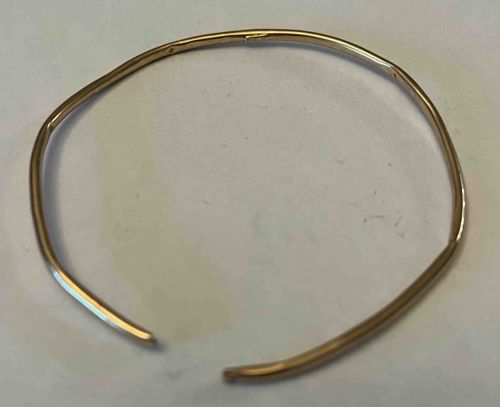
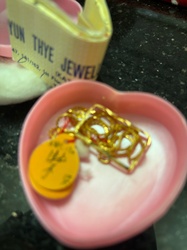
This item is a slender, open-ended cuff bracelet, likely made from a gold-toned metal, possibly gold or gold-plated. Its physical characteristics include a generally circular form that has been subtly distorted into an organic, wavy shape rather than a perfect circle. The material appears to be a solid wire, likely between 2-3mm in diameter, with a smooth, polished surface reflecting light. The color is a consistent warm yellow, characteristic of many gold alloys. There are no overt decorative elements or engravings, highlighting its minimalist design.
Notable features include the deliberate, uneven undulations along its circumference, which give it a unique, handcrafted appearance. At one point along the top edge, there appears to be a small, possibly stamped mark or indentation, which could be a maker's mark or karating stamp, though it's too indistinct to decipher from the image. The bracelet is an open-cuff style, meaning it does not close completely, allowing it to be slipped on and off the wrist.
Regarding condition, the surface exhibits minor scuffs and slight indentations typical of wear, but no significant damage like deep scratches, bends, or breaks beyond its intended open form. The overall condition appears good, with the metal retaining its luster. The craftsmanship suggests a piece designed to be comfortable and durable, focusing on form and the inherent beauty of the metal. It aligns with contemporary or modern minimalist jewelry styles, possibly from the late 20th or early 21st century given its simple and fluid lines.
AI Appraisal Report
Upon visual examination of the provided image, this Undulating Open Cuff Bracelet appears to be in good condition, showing minor scuffs and slight indentations consistent with regular wear, but no significant damage. The polished surface retains its luster. Based solely on the image, authenticity cannot be definitively confirmed. The warm yellow color suggests gold or gold-plated metal, and the minimalist design aligns with contemporary styles. Without physical inspection, the precise metal composition (e.g., karat of gold, base metal if plated) remains unknown. The small, indistinct mark mentioned could be a valuable maker's or purity stamp, but its legibility from the image is insufficient for verification.
Market conditions for minimalist jewelry, particularly in gold-toned metals, are generally stable, with consistent demand for understated, sculptural pieces. Comparables would include similar open-cuff designs from designers focusing on organic forms. The undulations contribute to its unique appeal, distinguishing it from mass-produced straight cuffs. Demand for such pieces is good among those seeking versatile, sophisticated accessories. Its rarity depends heavily on whether it's a unique artisan piece or from a limited production run, information not discernible from the image.
Key factors significantly impacting value are the actual metal content (solid gold vs. plated), the purity of the gold if solid, the designer/maker if identifiable, and its weight. Without these details, especially metal purity and weight, a precise valuation is challenging. For full authentication and accurate valuation, an in-person examination is crucial to identify and test the metal composition, assess the potential hallmark, and accurately weigh the piece. Provenance documentation, if available, would also provide significant value insight.