Paleo-Indian Chert Projectile Point Lithic Tool
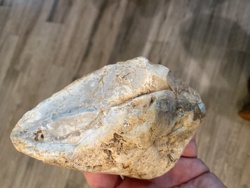
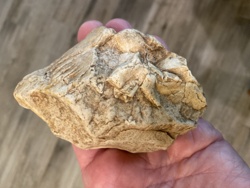
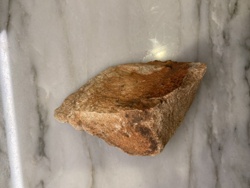
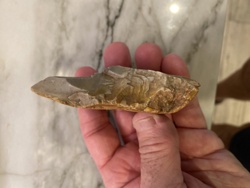
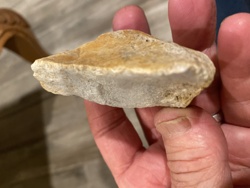
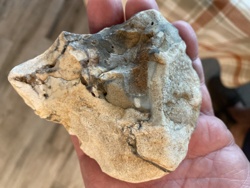
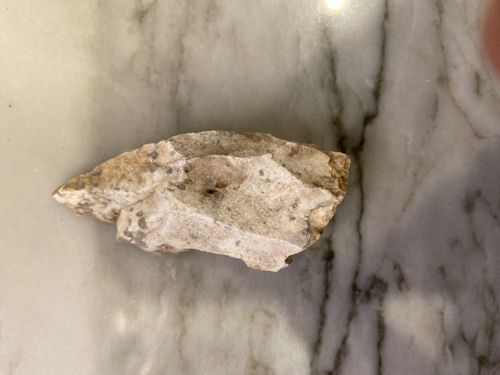
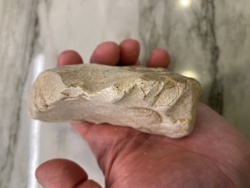
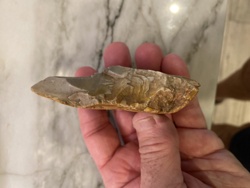
This artifact is a lithic projectile point or knife crafted from chert, measuring approximately 3 inches in length and 1.25 inches in width. Found in Guthrie, Oklahoma, this specimen is characteristic of Paleo-Indian tool-making traditions. The point exhibits an off-white to buff-colored cryptocrystalline silicate material, likely a local variety of chert, featuring a matte to slightly waxy texture. Physically, the item shows evidence of bifacial reduction through percussion and pressure flaking, though the flake scars appear weathered and less distinct over time. The edges show significant irregular wear and potential reworked areas, suggesting it may have functioned as a multifunctional scraping or cutting tool after its initial use as a point. The condition is consistent with long-term exposure to geological elements, displaying a heavy mineralized patina and some structural blunting at the tip and base. No modern maker's marks are present, signifying its ancient origin. The craftsmanship reflects the utilitarian high-efficiency skill of the Paleo-Indian period, roughly 10,000 to 12,000 years ago, where resource conservation and durability were paramount for survival.
AI-Generated Appraisal Disclaimer
Estimated Value
$150 - $350
Basic Information
Category
Archaeological Artifacts / Native American Lithics
Appraised On
February 28, 2026
Estimated Value
$150 - $350
Additional Details Provided By Owner
User Provided Information
Paleo Indian chert point found in Guthrie OK measuring 3" x 1.25"
Item Description
This artifact is a lithic projectile point or knife crafted from chert, measuring approximately 3 inches in length and 1.25 inches in width. Found in Guthrie, Oklahoma, this specimen is characteristic of Paleo-Indian tool-making traditions. The point exhibits an off-white to buff-colored cryptocrystalline silicate material, likely a local variety of chert, featuring a matte to slightly waxy texture. Physically, the item shows evidence of bifacial reduction through percussion and pressure flaking, though the flake scars appear weathered and less distinct over time. The edges show significant irregular wear and potential reworked areas, suggesting it may have functioned as a multifunctional scraping or cutting tool after its initial use as a point. The condition is consistent with long-term exposure to geological elements, displaying a heavy mineralized patina and some structural blunting at the tip and base. No modern maker's marks are present, signifying its ancient origin. The craftsmanship reflects the utilitarian high-efficiency skill of the Paleo-Indian period, roughly 10,000 to 12,000 years ago, where resource conservation and durability were paramount for survival.
Related Tags
Get Your Items Appraised
Instant estimates of your treasures with AI-powered instant appraisals