AI Appraisal Estimate

AI-generated estimates · not official valuations

From the user

What was submitted

Photo and notes provided by the user — not generated by AI

Submitted item photo
Submitted photo · May 27, 2026

User's notes

No additional notes provided.

AI analysis below

AI appraisal

AI analysis & estimate

AI-Generated · Verify before acting

Everything below is generated by AI for informational purposes only. AI can make mistakes — the AI may misidentify items or misattribute them (artist, maker, brand, designer, origin, era). This is not an official valuation and should not be used for insurance, sale, tax, estate, legal, or lending purposes — or any decision requiring a certified appraisal. It is not an authoritative claim about any person, brand, or rights holder — do not share or rely on it as a factual statement about a third party. Always consult qualified professionals before making financial decisions.

Read the full disclaimer

AI Identification

·Not independently authenticated·Verify before acting

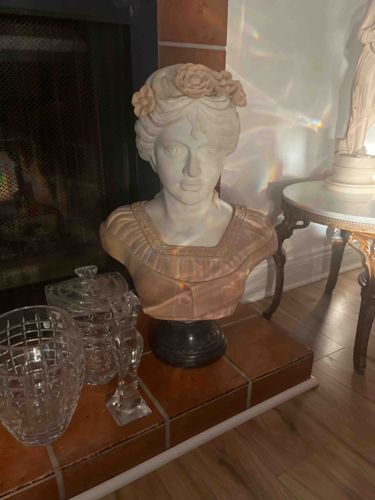
Neoclassical Style Carved Alabaster or Marble Bust of a Young Woman

Fine Art Sculpture

AI Estimated Value

·Not an official valuation·Verify before acting

$450 - $700

As of May 27, 2026

AI Item Analysis

·AI can make mistakes·Verify before acting
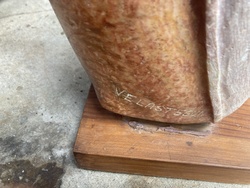
This is a decorative sculpture featuring the bust of a young woman, likely executed in carved alabaster or a similar soft stone, indicated by the material's translucency and subtle peach/pink veining in the lower bodice and hair floral crown. The subject is depicted with youthful features, large eyes, and hair styled with a central part, adorned with a woven garland of roses. Her attire consists of a pleated gown with a textured, rectangular-patterned trim around the neckline. The piece exhibits a two-tone appearance, where the face and neck are a matte white, possibly due to a chalky surface deposit or different finishing technique, while the chest and base of the bust show a warmer, tan-colored mineral staining. The entire bust is mounted on a contrasting dark, turned socle base, likely made of black marble or painted wood. In terms of condition, there is a visible layer of surface dust and potential light oxidation or handling grime, particularly in the recessed details of the hair and dress. There appear to be minor scuffs along the lower edge of the bust where it meets the pedestal. This style is inspired by late 19th-century Victorian or early 20th-century Italian neoclassical revivals, aiming for a romanticized classical aesthetic. The craftsmanship shows careful attention to the drapery of the clothing and the individual petals of the floral crown, suggesting a hand-finished production intended for interior decoration.
AI Appraisal Report

·AI can make mistakes·Verify before acting
I have conducted a visual examination of the Neoclassical style bust, likely dating from the late 19th to early 20th century. My assessment identifies the material as carved alabaster, evidenced by the characteristic translucency and natural mineral veining visible in the lower torso. The craftsmanship reflects a high-quality Italian workshop tradition, commonly found in the 'Grand Tour' or decorative export market of the era. The two-tone finish—a luminous white for the skin and a variegated ochre for the garments—is a deliberate aesthetic choice common in Victorian-era portraiture to enhance realism. Condition-wise, the piece shows age-appropriate surface accumulation and minor scuffing at the base contact points. The absence of major structural fractures or losses to the delicate rose petals in the hair wreath significantly supports the value. Market demand for such decorative period pieces remains stable for interior designers seeking 'Old World' elegance, though prices have softened compared to 1980s peaks. Comparables realized at auction for unsigned alabaster busts of this size typically fall within the $400 to $800 range. Limitations: This appraisal is based solely on high-resolution images. Authenticity as an original 19th-century carving versus a high-quality mid-century reproduction cannot be definitively confirmed without an in-person inspection. I would require a tactile examination to check for machine-tool marks versus hand-carving signatures. Furthermore, provenance documentation or a chemical analysis of the socle attachment would be necessary to rule out composite materials or modern cast restorations. Final valuation may fluctuate based on the discovery of an artist's signature on the reverse.

Get your items appraised

Instant estimates of your treasures with AI-powered appraisals

Browse More Appraisals