AI Appraisal Estimate

AI-generated estimates · not official valuations

From the user

What was submitted

Photo and notes provided by the user — not generated by AI

Submitted item photo
Submitted photo · June 3, 2026

User's notes

No additional notes provided.

AI analysis below

AI appraisal

AI analysis & estimate

AI-Generated · Verify before acting

Everything below is generated by AI for informational purposes only. AI can make mistakes — the AI may misidentify items or misattribute them (artist, maker, brand, designer, origin, era). This is not an official valuation and should not be used for insurance, sale, tax, estate, legal, or lending purposes — or any decision requiring a certified appraisal. It is not an authoritative claim about any person, brand, or rights holder — do not share or rely on it as a factual statement about a third party. Always consult qualified professionals before making financial decisions.

Read the full disclaimer

AI Identification

·Not independently authenticated·Verify before acting

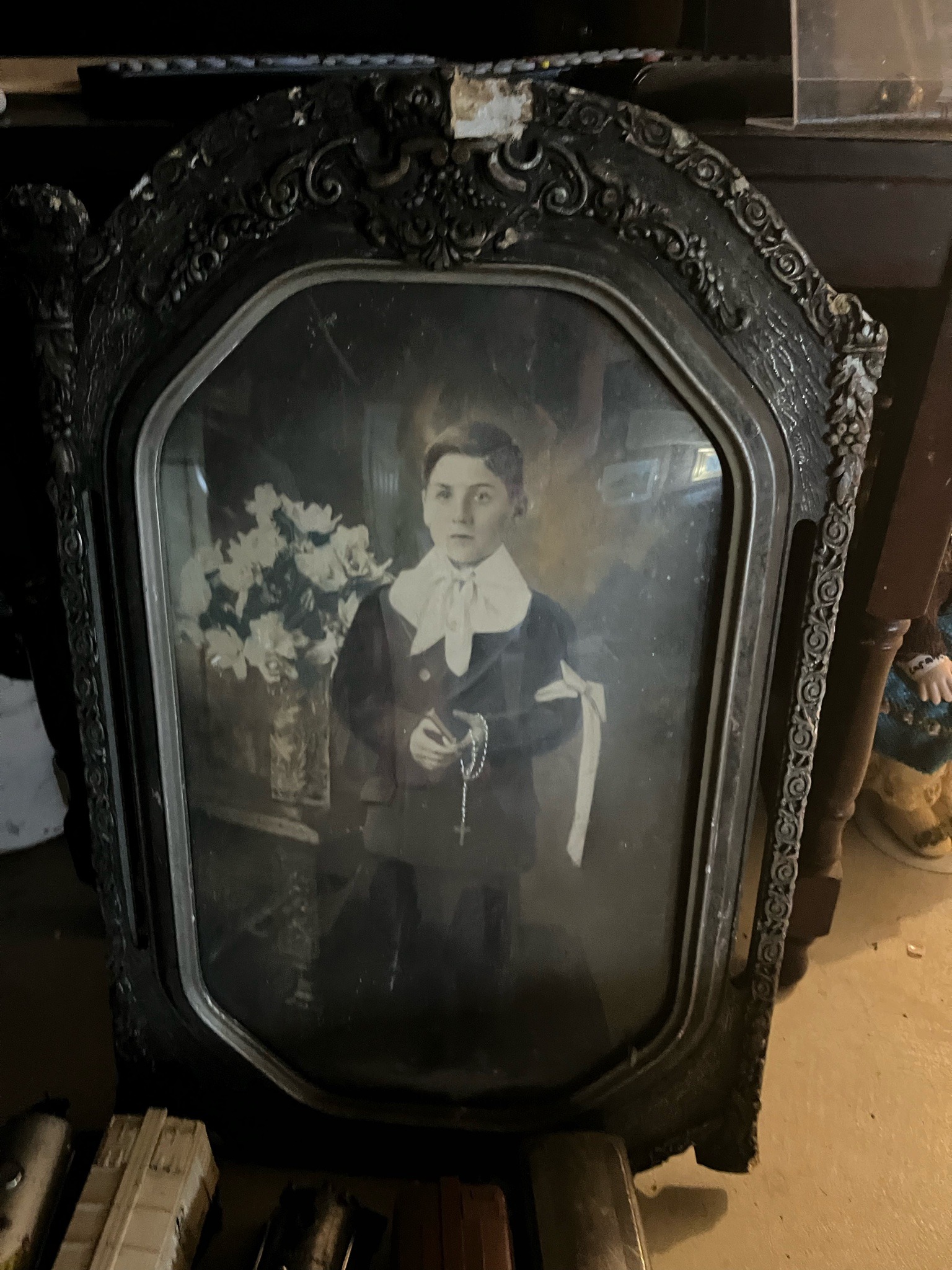
Late-19th to early-20th-century style framed hand-colored portrait

Art and Photography

AI Estimated Value

·Not an official valuation·Verify before acting

$150 - $350

As of June 3, 2026

AI Item Analysis

·AI can make mistakes·Verify before acting
This item is a large, octagonal-aperture portrait housed in a heavily ornate, dark-toned frame. The image appears to be a hand-colored photograph or 'crayon portrait,' stylistically consistent with late-19th or early-20th-century memorial or ceremonial photography. The subject is a young boy dressed in dark formal attire, featuring a wide white collar and an armband, holding what appears to be a rosary, which suggests a First Communion or religious observance context. The background includes a vase of white flowers, possibly lilies. The frame is characteristic of the Victorian or Edwardian eras, displaying complex rococo-style scrolls, floral motifs, and a crest-like top edge. Materials likely include cast gesso over wood for the frame and paper or canvas for the portrait. Significant condition issues are visible: the frame has considerable surface dust, possible gesso loss, and a notable piece of white adhesive tape or a paper label remnant at the top center crest. The portrait itself appears through aged glass which shows surface reflections and possible internal clouding or foxing. Because no signature or photographer's mark is visible in the image, the dating and origin are based solely on stylistic markers and typical manufacturing techniques of that era.
AI Appraisal Report

·AI can make mistakes·Verify before acting
Based on the provided imagery, I have evaluated this octagonal-aperture portrait within its ornate frame. The item appears to be a hand-colored 'crayon portrait' or solar print, a medium popular in the late-19th to early-20th centuries. The imagery suggests a religious milestone, such as a First Communion. From what I can see, the frame is a significant component of the item's appeal, featuring rococo-style gesso ornamentation that was common during the Victorian and Edwardian eras. However, I cannot verify from a photo whether the frame is solid wood with hand-carved elements or, more likely, cast gesso over a secondary wood. I also cannot determine the exact state of the portrait's surface behind the glass, though I observe what appears to be foxing or internal clouding. The value estimate is based on the hypothesis that the piece is a period-correct ensemble from approximately 1890–1915. Items of this type currently see modest demand in the secondary market, primarily as decorative pieces or for collectors of religious and genealogical ephemera. The visible condition issues—including possible gesso loss and adhesive residue on the crest—negatively impact the valuation. If this piece were found to be a more modern reproduction using synthetic materials or a digital print, the value would likely drop below $50. Conversely, if physical inspection by a conservator determined the frame and portrait to be in excellent structural condition with a documented provenance, it might reach the higher end of the range. To confirm my assumptions regarding the age and materials, an in-person examination of the frame's backing and the medium's grain under magnification would be necessary to rule out later 20th-century lithographic reproductions.

Get your items appraised

Instant estimates of your treasures with AI-powered appraisals

Browse More Appraisals