AI estimate as of September 1, 2025 · verify with a professional before acting
AI-Generated · Verify before acting
Everything on this page is generated by AI for informational purposes only. AI can make mistakes — the AI may misidentify items or misattribute them (artist, maker, brand, designer, origin, era). This is not an official valuation and should not be used for insurance, sale, tax, estate, legal, or lending purposes — or any decision requiring a certified appraisal. It is not an authoritative claim about any person, brand, or rights holder — do not share or rely on it as a factual statement about a third party. Always consult qualified professionals before making financial decisions.
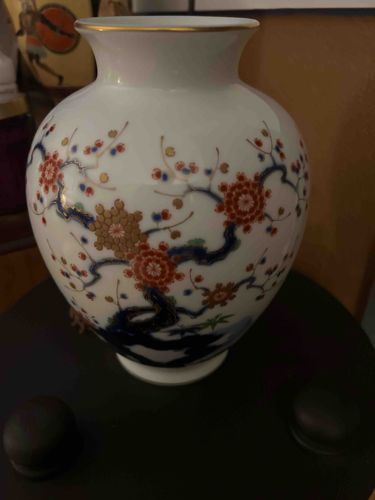
This is a globular-shaped porcelain vase, primarily white with multi-colored hand-painted decorations. The vase features a narrow, slightly flared neck, which is rimmed with a thin band of gilt or gold-colored paint, indicating a possible decorative accent or higher quality finish. The main body of the vase is adorned with an elaborate floral and botanical motif, likely depicting cherry or plum blossoms (sakura/ume) on dark blue, gnarled branches. The blossoms are rendered in various shades of red, reddish-orange, and golden-brown, with smaller blue and red accents representing berries or buds scattered throughout the composition. Some of the floral elements appear to have additional gold detailing, suggesting raised enamel or gilt application which adds texture and richness. The base of the vase is a clean, unadorned white. The craftsmanship appears to be of good quality, with clear, vibrant colors and intricate detailing in the painting. No obvious chips, cracks, or repairs are visible from the provided images, suggesting the vase is in good to excellent condition. The surface appears smooth and glossy, indicative of a well-fired glaze. The style strongly suggests an East Asian, most likely Japanese, influence, possibly from the mid-20th century or earlier, given the traditional floral patterns. The combination of intricate design and gilt highlights points towards a decorative rather than utilitarian purpose, possibly a display piece.
AI Appraisal Report
Based on my visual examination of the provided image, this Japanese Porcelain Floral Vase appears to be in very good to excellent condition. I observe no obvious chips, cracks, or repairs, and the surface exhibits a smooth, glossy glaze indicative of proper firing. The hand-painted multi-colored floral and botanical motif, likely cherry or plum blossoms on dark blue branches, is vibrant and intricate, with notable gilt or gold-colored detailing on the rim and within some floral elements, suggesting a higher quality decorative finish. This level of detail and traditional patterning points strongly to a Japanese origin, likely mid-20th century or possibly earlier, which is typical for such decorative pieces.
Market conditions for mid-century decorative Japanese porcelain vases are generally stable, with demand often driven by aesthetic appeal for home decor. Comparables in similar condition and artistic quality typically retail between $100 and $400, depending on provenance, artist/kiln identification, and uniqueness. The intricate painting and good condition of this specific example position it towards the upper end of common decorative pieces within this category. While it possesses decorative merit, it doesn't appear to represent a rare or highly sought-after artist or period that would command premium prices. The absence of maker's marks or signatures, which cannot be discerned from the image, limits its potential rarity and, consequently, its top market value.
However, it is crucial to state that my authentication and detailed assessment are limited by reliance on images alone. To definitively confirm authenticity, assess precise age, and fully evaluate potential conservation issues, a thorough in-person examination would be necessary. This would allow for tactile inspection of the porcelain body, detailed scrutiny of the paint application and gilt work under magnification, and a check for any hidden repairs or restorations. Furthermore, the presence of any maker's marks on the base would significantly aid in precise dating and attribution. Provenance documentation, if available, would also be invaluable for historical context and value determination. Scientific testing, while possible, is generally not warranted for items in this value range unless specific authenticity concerns arise.