AI Appraisal Estimate

AI-generated estimates · not official valuations

From the user

What was submitted

Photo and notes provided by the user — not generated by AI

Submitted item photo
Submitted photo · June 12, 2026

User's notes

No additional notes provided.

AI analysis below

AI appraisal

AI analysis & estimate

AI-Generated · Verify before acting

Everything below is generated by AI for informational purposes only. AI can make mistakes — the AI may misidentify items or misattribute them (artist, maker, brand, designer, origin, era). This is not an official valuation and should not be used for insurance, sale, tax, estate, legal, or lending purposes — or any decision requiring a certified appraisal. It is not an authoritative claim about any person, brand, or rights holder — do not share or rely on it as a factual statement about a third party. Always consult qualified professionals before making financial decisions.

Read the full disclaimer

AI Identification

·Not independently authenticated·Verify before acting

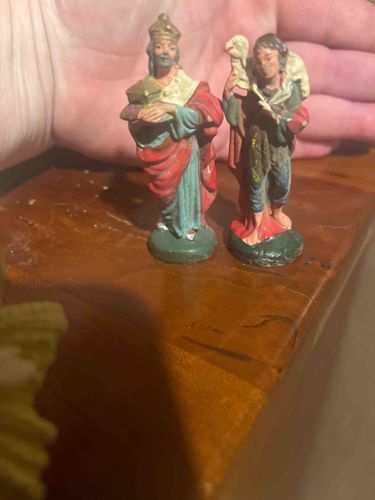
Vintage Miniature Composition Nativity Figurines (King and Shepherd)

Religious Art and Holiday Collectibles

AI Estimated Value

·Not an official valuation·Verify before acting

$15 - $25

As of June 12, 2026

AI Item Analysis

·AI can make mistakes·Verify before acting
A pair of vintage miniature nativity set figurines, approximately 2 to 3 inches in height, depicting a Wise Man (King) holding a chest and a Shepherd carrying a sheep. These figures are likely constructed from papier-mâché or a similar composition material, which was common for European-made nativity sets (often from Germany or Italy) mid-20th century, typically between the 1930s and 1950s. The King is adorned in a red and blue robe with a gold-colored crown, while the Shepherd features more muted earth tones with a white lamb draped over his shoulders. Both figures stand on integrated green circular bases. The craftsmanship displays hand-painted details that, while charming, show significant signs of aged wear including visible paint loss, chipping on the edges of the bases, and a general dulling of the original pigments. Specifically, the King has notable paint loss on his chest and face, while the Shepherd shows scuffing on his legs and the sheep's wool. The texture is slightly granular, suggesting a molded composite rather than carved wood or plastic. These items characterize a traditional folk-art style prevalent in holiday decor from the post-war era.
AI Appraisal Report

·AI can make mistakes·Verify before acting
I have carefully examined the digital documentation of these two miniature nativity figurines, identified as a King and a Shepherd. Based on my visual analysis, these pieces appear to be mid-20th-century (circa 1940s-1950s) composition figures, likely of German or Italian origin. The material displays the characteristic granular texture of molded sawdust/glue composition typical of the post-war era. The paint application follows the folk-art aesthetic of that period. The condition is assessed as 'fair to good' for their age; there is significant honest wear, including paint loss on the King’s chest and scuffing on the sheep. These losses detract from the aesthetic value but confirm the item's age and material composition. In terms of market conditions, these figures are quite common and were produced in massive quantities for the global export market. Rarity is low. Collectors typically seek complete sets in 'very good' to 'excellent' condition, or specific signed pieces (such as Marolin). Since these are incomplete fragments of a larger set and show notable degradation, their value is primarily sentimental or utilitarian for a collector looking for replacement parts for an existing set. Please note that this appraisal is based on image analysis alone. A definitive authentication would require a physical inspection to confirm the presence of inner wire armatures and to differentiate between papier-mâché and modern resin reproductions. I would also look for stamped marks on the underside of the bases, such as 'Germany' or 'Italy,' which would provide more specific provenance. No scientific testing is recommended given the low market value.

Get your items appraised

Instant estimates of your treasures with AI-powered appraisals

Browse More Appraisals