AI estimate as of December 8, 2025 · verify with a professional before acting
AI-Generated · Verify before acting
Everything on this page is generated by AI for informational purposes only. AI can make mistakes — the AI may misidentify items or misattribute them (artist, maker, brand, designer, origin, era). This is not an official valuation and should not be used for insurance, sale, tax, estate, legal, or lending purposes — or any decision requiring a certified appraisal. It is not an authoritative claim about any person, brand, or rights holder — do not share or rely on it as a factual statement about a third party. Always consult qualified professionals before making financial decisions.
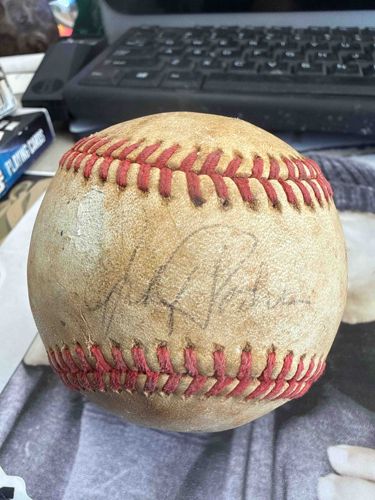
The item is a standard-sized baseball, traditionally constructed with a white leather or synthetic leather cover and characteristic red stitching. The cover has a noticeable cream or off-white hue, suggesting age and/or field use rather than being pristine white. The red stitching, a prominent feature, is in a classic figure-eight pattern, securely holding the two panels of the ball together. There are 108 stitches visible on each side of the seam, consistent with regulation baseballs. The most distinguishing feature is an autograph rendered in black ink, appearing on one of the leather panels. While the signature's legibility is somewhat challenged by wear, it appears to be a multi-part signature. The ink is somewhat faded and shows minor smudging in areas, indicative of handling over time. The overall condition of the baseball demonstrates significant wear: the white covering is discolored with dirt and scuffs, suggesting it has been used in play or handled extensively. There are scuff marks and abrasions on the surface, particularly noticeable near the stitching. Despite the wear and discoloration, the structural integrity of the ball appears intact, with no visible tears to the cover or loose stitching. The ball lacks any obvious manufacturing stamps or logos that would typically be found on a new, officially licensed baseball, which could indicate it’s an older ball or one not intended for official league play. The style and construction suggest it could date from the mid-20th century to the late 20th century, though a precise age is difficult to determine without further marks. The presence of an autograph elevates this item from a mere sporting good to a piece of memorabilia, whose value would heavily depend on the identity and authentication of the signer.
AI Appraisal Report
I have examined the image of this autographed baseball. The ball itself appears to be a standard-sized baseball, exhibiting significant wear with a cream or off-white discoloration, scuffs, and dirt, suggesting extensive handling or use. The red stitching is intact, and the overall structural integrity seems sound, despite its aged appearance. There are no visible manufacturer logos, which could indicate an older ball or one not intended for official play, making precise dating difficult from the image alone. The most significant feature is the autograph in black ink. While its legibility is challenged by fading and minor smudging, it appears to be a multi-part signature.
Based on visual examination, the condition of the ball is poor to fair due to heavy wear and discoloration. The faded and smudged autograph further detracts from its aesthetic appeal and makes authentication challenging. For market conditions, autographed baseballs have a wide value range, heavily dependent on the signer's identity, rarity, and the signature's condition and authenticity. Comparables vary greatly; a common player's faded autograph on a beat-up ball would fetch minimal value, while a Hall of Famer's clear, authenticated signature commands significant premiums.
Demand for an item like this is currently low without a verified signer. Rarity is difficult to assess without knowing the signer. The primary factor impacting value is the identity and authenticity of the signature. Currently, the value is low due to the unknown signer and condition.
Limitations for authenticity verification from images alone are substantial. I cannot definitively identify the signer or confirm the autograph's authenticity. For full authentication, in-person examination is crucial to assess the ink, pressure, and letter formation microscopic details. Provenance documentation (e.g., photos of signing, certificates) would significantly enhance value, and scientific testing of the ink could potentially aid in dating. Without these, this item is a speculative piece.