AI Appraisal Estimate

AI-generated estimates · not official valuations

From the user

What was submitted

Photo and notes provided by the user — not generated by AI

Submitted item photo
Submitted photo · June 8, 2026

User's notes

No additional notes provided.

AI analysis below

AI appraisal

AI analysis & estimate

AI-Generated · Verify before acting

Everything below is generated by AI for informational purposes only. AI can make mistakes — the AI may misidentify items or misattribute them (artist, maker, brand, designer, origin, era). This is not an official valuation and should not be used for insurance, sale, tax, estate, legal, or lending purposes — or any decision requiring a certified appraisal. It is not an authoritative claim about any person, brand, or rights holder — do not share or rely on it as a factual statement about a third party. Always consult qualified professionals before making financial decisions.

Read the full disclaimer

AI Identification

·Not independently authenticated·Verify before acting

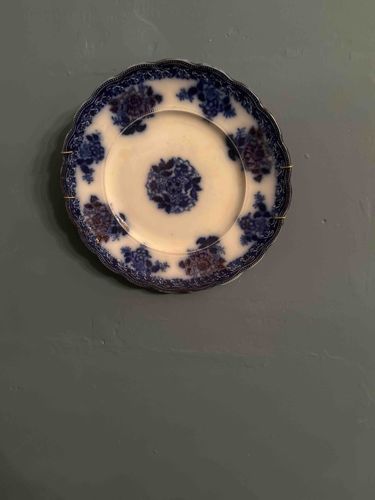
Scalloped Blue and White Transferware Plate

Decorative Plate

AI Estimated Value

·Not an official valuation·Verify before acting

$60 - $120

As of June 8, 2026

AI Item Analysis

·AI can make mistakes·Verify before acting
This item is a decorative porcelain or ceramic plate featuring a predominant blue and white transferware design. The plate has a distinctive scalloped or crimped edge, adding to its ornamental appeal. The central motif is a dense, circular floral pattern in a deep cobalt blue, which might be slightly muted, characteristic of flow blue ware. Surrounding this central design, the rim of the plate is adorned with additional, irregularly spaced floral clusters and vine-like patterns, also in varying shades of blue, including areas where the blue has 'flowed' or blurred slightly, a common trait in flow blue ceramics. The background is a clean, off-white or cream color, providing a strong contrast to the blue imagery. The reverse side of the plate is not visible, so details on maker's marks or specific manufacturing indicators are not discernible from the image. The plate appears to be in good overall condition with no obvious chips, cracks, or significant visible wear, though some minor age-appropriate crazing or faint discoloration might be present upon closer inspection. The absence of visible chips or severe patina suggests it has been well-preserved, likely used as a display piece, indicated by the partial visibility of a plate hanger. Based on the style and patterning, it appears to be an antique or vintage piece, likely from the late 19th or early 20th century, consistent with the popularity of flow blue and transferware during that period. The craftsmanship appears to be of good quality, with clear pattern application and a well-formed body.

AI Appraisal Report

·AI can make mistakes·Verify before acting
Upon my virtual examination of this Scalloped Blue and White Transferware Plate, I observe a well-preserved piece. The condition appears to be good; I see no obvious chips, cracks, or significant wear from the provided image. The scalloped edge and transferware design, with the characteristic 'flowed' appearance of the blue, strongly suggest it is a genuine antique or vintage item, likely late 19th to early 20th century. This aligns with the historical popularity of flow blue and transferware. The partial visibility of a plate hanger indicates its use as a decorative item, contributing to its good state of preservation. From a market perspective, traditional flow blue transferware decorative plates typically see moderate demand. While highly collectible, individual plates without a known prestigious maker or exceptionally rare pattern tend to fall within an accessible price range. Comparables in similar condition and style, particularly single plates rather than sets, usually fetch between $60 and $120 at auction or through reputable dealers. The aesthetic appeal of the ornate floral motif and scalloped rim enhances its desirability. Key factors impacting value here are the overall condition, which appears excellent, and the visual appeal of the pattern. Rarity is difficult to ascertain without seeing maker's marks, but the pattern does not immediately strike me as exceedingly rare. The main limitation in my authenticity verification is the absence of a physical examination. To provide a definitive authentication, I would require an in-person inspection to check for crazing, examine the foot rim and glaze for manufacturing characteristics, and especially to identify any maker's marks on the reverse. Provenance documentation, though unlikely for a single decorative plate, would also be beneficial to confirm its age and origin. Scientific testing for material composition is generally not necessary for this type of ceramic unless there were significant doubts about its age.

Get your items appraised

Instant estimates of your treasures with AI-powered appraisals

Browse More Appraisals