AI Appraisal Estimate

AI-generated estimates · not official valuations

From the user

What was submitted

Photo and notes provided by the user — not generated by AI

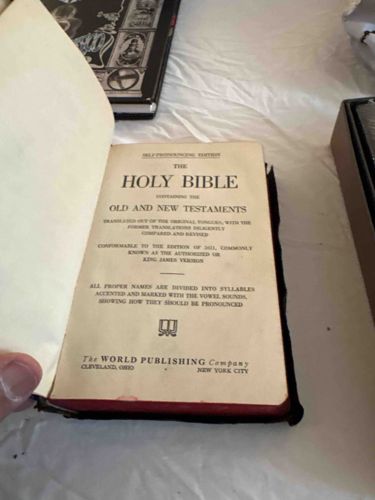
Submitted item photo
Submitted photo · June 18, 2026

User's notes

No additional notes provided.

AI analysis below

AI appraisal

AI analysis & estimate

AI-Generated · Verify before acting

Everything below is generated by AI for informational purposes only. AI can make mistakes — the AI may misidentify items or misattribute them (artist, maker, brand, designer, origin, era). This is not an official valuation and should not be used for insurance, sale, tax, estate, legal, or lending purposes — or any decision requiring a certified appraisal. It is not an authoritative claim about any person, brand, or rights holder — do not share or rely on it as a factual statement about a third party. Always consult qualified professionals before making financial decisions.

Read the full disclaimer

AI Identification

·Not independently authenticated·Verify before acting

The Holy Bible, King James Version, Self-Pronouncing Edition (World Publishing Company)

Antique and Vintage Books

AI Estimated Value

·Not an official valuation·Verify before acting

$15.00 - $35.00

As of June 18, 2026

AI Item Analysis

·AI can make mistakes·Verify before acting
This is a vintage edition of the Holy Bible containing both the Old and New Testaments, published by the World Publishing Company of Cleveland and New York. The title page identifies it as a 'Self-Pronouncing Edition,' a feature designed to help readers with the phonetic pronunciation of proper names through syllable division and vowel markings. The text is the Authorized King James Version, based on the 1611 edition. The book features a black, likely imitation leather or flexible bonded leather binding with overlapping edges (yapp style). The page edges are finished with a red stained or 'red-under-gold' effect, though the gilding appears faded or absent in the visible edges. Physically, the paper shows significant age-related toning, turning a creamy off-white or yellowish hue common in mid-20th-century mass-market religious publications. There is visible wear to the cover’s edges and corners, and a notable reddish stain or liquid damage mark is seen at the bottom edge of the title page. The binding shows signs of separation at the hinge where the cover meets the text block. Typical of World Publishing Company editions from the 1940s to the 1960s, it represents a utilitarian rather than luxury production, aimed at personal study or family use. There are no immediate signs of a family record section in this view, but the small-to-medium octavo format suggests a portable 'hand bible' size.
AI Appraisal Report

·AI can make mistakes·Verify before acting
Based on my visual examination of this King James Version Bible published by World Publishing Company, I have assessed it as a mid-20th-century mass-market production, likely dating between 1945 and 1960. While the text block is the venerable 1611 KJV, this specific 'Self-Pronouncing Edition' was produced in high volume for general consumer use. The condition is Fair to Good. I noted significant age-related toning, cover wear, and a concerning liquid stain on the title page, which may indicate latent mold risk. The yapp-style binding shows structural fatigue at the hinges, a common failure point for bonded leather of this era. The market for vintage Bibles is heavily bifurcated; high value is reserved for 17th-19th century editions, rare fine bindings (such as morocco leather), or copies with significant, verifiable provenance. This edition is a 'utilitarian' volume. Comparables on the secondary market frequently sell in the $10 to $40 range depending on the presence of a family registry. Rarity is non-existent, as millions of these World Publishing editions remain in circulation. Critically, this appraisal is based on image analysis and carries limitations. I cannot verify the specific chemical composition of the binding or the extent of the internal acidic decay of the paper. A full authentication would require an in-person physical inspection to check for hidden foxing, determine if the red-under-gold gilt remains intact on the top edge, and search for internal markings or a family history section that might add marginal localized value. Without a primary source provenance or a unique historical association, its value remains primarily sentimental or as a decorative vintage object.

Get your items appraised

Instant estimates of your treasures with AI-powered appraisals

Browse More Appraisals