These notes were written by the person who submitted this item. Appraiser.AI has not verified them, and the AI's identification and estimate may rely on them.
AI Estimated Value
Not an official valuation
$250-400
AI estimate as of November 27, 2025 · verify with a professional before acting
AI-Generated · Verify before acting
Everything on this page is generated by AI for informational purposes only. AI can make mistakes — the AI may misidentify items or misattribute them (artist, maker, brand, designer, origin, era). This is not an official valuation and should not be used for insurance, sale, tax, estate, legal, or lending purposes — or any decision requiring a certified appraisal. It is not an authoritative claim about any person, brand, or rights holder — do not share or rely on it as a factual statement about a third party. Always consult qualified professionals before making financial decisions.
This analysis also relies on unverified notes provided by the user, which may be incomplete or inaccurate and could affect the result.
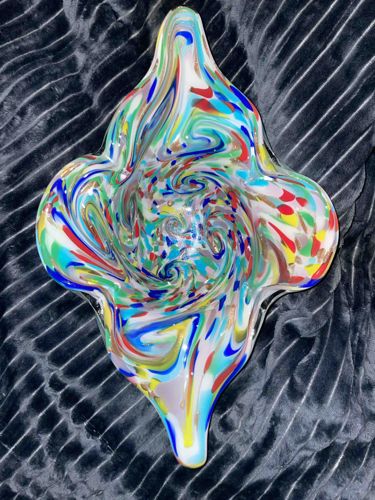
This exquisite item is a vibrant art glass bowl, likely of Murano origin, featuring a distinctive quatrefoil or lobed shape. The primary material is clear glass heavily infused with a 'millefiori' or 'fazzoletto' style technique, characterized by a multitude of small, irregularly shaped flecks and swirls of various colored glass. The palette is exceptionally rich and diverse, including vivid blues (both royal and light), emerald green, bright red, sunny yellow, white, brown, and possibly subtle hints of purple or amber, all suspended within a clear glass matrix. The colors are swirled together, creating a dynamic, almost chaotic pattern that radiates from the center of the bowl outward. The edges of the bowl are gracefully flared and undulating, giving it a soft, organic feel. The interior surface appears smooth and glossy, indicative of polished glass, while the exterior may have a subtle texture from the embedded glass pieces. No obvious chips, cracks, or repairs are visible from the provided images, suggesting good overall condition. Small air bubbles, common in hand-blown art glass, may be present within the material but are not discernible as significant flaws. The craftsmanship indicates a hand-blown or hand-formed technique, typical of Murano glassmakers from the mid-20th century onwards, often described as 'fazzoletto' (handkerchief) style due to its flowing, fabric-like appearance. The complex color application and irregular form point to a skilled artisan. The piece lacks any discernible maker's marks or signatures in the provided views, which is not uncommon for this type of glass.
AI Appraisal Report
Based on my visual examination of the provided image, this Murano-style Millefiori Art Glass Bowl is a beautiful example of decorative art glass. The 'fazzoletto' (handkerchief) form with its lobed, undulating edges is characteristic, as is the vibrant and diverse color palette suspended within the clear glass matrix. I observe a rich array of colors including blues, greens, reds, yellows, and white, swirled dynamically throughout the piece. The overall condition appears to be very good; I see no obvious chips, cracks, or repairs, which is crucial for maintaining value. Small air bubbles, if present, are typical of hand-blown glass and would not significantly detract from its appeal.
From a market perspective, comparable Murano millefiori or fazzoletto bowls of this size and complexity, especially those without a clear maker's mark, typically fetch between $250 and $400 at auction or through reputable dealers. The demand for well-executed Murano-style art glass remains steady among collectors of decorative arts. While 'millefiori' and 'fazzoletto' techniques are not rare themselves, the quality of color application and the absence of damage contribute to its desirability. The lack of any discernible signature or maker's mark, while not uncommon, does impact the top-end valuation, as signed pieces by known masters command higher prices.
It is important to note the limitations of an appraisal based solely on images. While the style strongly suggests Murano craftsmanship, full authentication would require in-person examination to inspect the pontil mark, analyze the glass composition, and confirm the absence of subtle damage or repairs not visible in photographs. Provenance documentation, such as purchase receipts or historical ownership records, would also significantly aid in authenticating its origin and potentially increasing its value.