AI estimate as of July 18, 2025 · verify with a professional before acting
AI-Generated · Verify before acting
Everything on this page is generated by AI for informational purposes only. AI can make mistakes — the AI may misidentify items or misattribute them (artist, maker, brand, designer, origin, era). This is not an official valuation and should not be used for insurance, sale, tax, estate, legal, or lending purposes — or any decision requiring a certified appraisal. It is not an authoritative claim about any person, brand, or rights holder — do not share or rely on it as a factual statement about a third party. Always consult qualified professionals before making financial decisions.
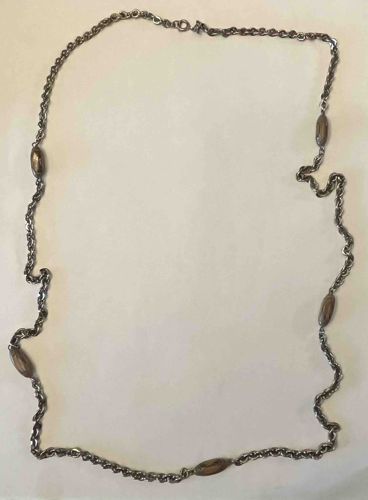
This is a long, silver-toned chain necklace interspersed with five oval, barrel-shaped beads. The chain appears to be constructed from interlocking links, possibly of a rolo or cable chain style, with a slightly darkened, antiqued finish suggesting tarnish or intentional patination. The links appear individually formed, indicating a degree of craftsmanship. The overall length of the necklace is substantial, designed to be worn as a opera or lariat style, or possibly doubled. The five beads are equally spaced along the length of the chain and exhibit a smooth, semi-reflective surface with variations in tone, indicating they might be made of a natural material such as wood, stone, or a metallic alloy with a different finish than the chain. The beads are a warm, brownish-bronze color, providing a subtle contrast to the cooler silver tone of the chain. One end of the chain shows a small, simple clasp mechanism, possibly a spring ring clasp, which appears functional but has some visible wear or discoloration. There are no clear manufacturer's marks or signatures visible from the image. The style of the necklace suggests it could be from the mid-20th century to contemporary, with a timeless design. The condition appears good overall, with consistent patination throughout the chain, and no apparent significant damage to the beads. The quality of construction seems suitable for costume or fashion jewelry, and the uniform appearance of the links and bead placement indicates reasonable attention to detail.
AI Appraisal Report
I have carefully examined the provided image of this long, silver-toned chain necklace with five oval barrel beads. Based on my visual assessment, the necklace appears to be in good overall condition. The chain exhibits uniform patination, suggesting either intentional antiquing or consistent wear. The links appear well-formed, indicative of reasonable costume jewelry construction. The barrel beads are evenly spaced and show no obvious signs of chips or cracks, presenting a smooth, semi-reflective surface. The color contrast between the cool silver-toned chain and the warm, brownish-bronze beads is aesthetically pleasing and timeless.
From a market perspective, this piece falls into the broad category of fashion or costume jewelry. Its design is classic, capable of complementing various styles from vintage to contemporary. Demand for such versatile pieces remains steady, especially for longer necklaces that offer different styling options (e.g., doubled or opera length). While not rare, its good condition and classic appeal make it desirable.
Key factors impacting value include its material composition (which cannot be definitively determined from an image), the absence of maker's marks, and the visible wear on the clasp. If the beads were proven to be a natural, semi-precious stone or a higher quality metal, the value would increase significantly. However, without physical examination, I must assume materials typical for costume jewelry.
Limitations in authenticity verification are significant here. Without in-person examination, I cannot confirm the exact metal content of the chain or the composition of the beads (wood, ceramic, base metal with plating, etc.). A physical inspection would allow for tactile assessment, a more thorough evaluation of the clasp's integrity, and the search for any subtle marks. Scientific testing (e.g., XRF analysis) would be needed to determine metal composition, and gemological testing for the beads, if they are purported to be natural materials. Provenance documentation, if available, would also add to authenticity and value.