AI Appraisal Estimate

AI-generated estimates · not official valuations

From the user

What was submitted

Photo and notes provided by the user — not generated by AI

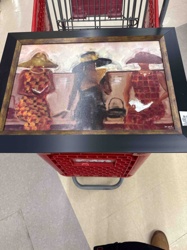
Submitted item photo
Submitted photo · June 20, 2026

User's notes

No additional notes provided.

AI analysis below

AI appraisal

AI analysis & estimate

AI-Generated · Verify before acting

Everything below is generated by AI for informational purposes only. AI can make mistakes — the AI may misidentify items or misattribute them (artist, maker, brand, designer, origin, era). This is not an official valuation and should not be used for insurance, sale, tax, estate, legal, or lending purposes — or any decision requiring a certified appraisal. It is not an authoritative claim about any person, brand, or rights holder — do not share or rely on it as a factual statement about a third party. Always consult qualified professionals before making financial decisions.

Read the full disclaimer

AI Identification

·Not independently authenticated·Verify before acting

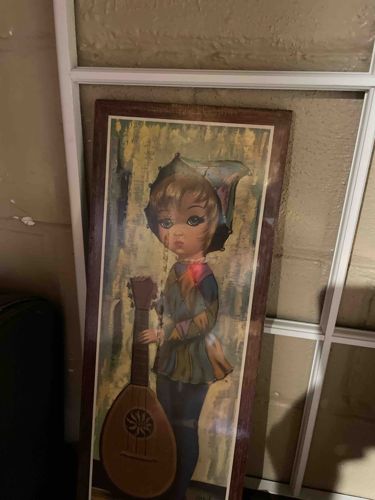
Vintage Mid-Century Big-Eyed Jester Girl with Lute Print

Vintage Decor / Visual Art

AI Estimated Value

·Not an official valuation·Verify before acting

$15.00-$30.00

As of June 20, 2026

AI Item Analysis

·AI can make mistakes·Verify before acting
This item is a tall, rectangular vertical art print featuring a stylized 'big-eyed' child figure dressed in a colorful jester or harlequin-style costume, holding a large lute. The artwork represents the popular mid-twentieth-century 'Big Eye' art movement. The figure possesses large, melancholic eyes, a small mouth, and blonde hair under a pointed cap colored with muted blues and purples. The costume consists of a jagged, multi-toned tunic and dark blue tights. The background is rendered in an impressionistic, textural style with vertical strokes of pale yellow, cream, and green. The print is mounted within a simple, dark wood-grain border, which appears to be either a thin wooden frame or a printed border on a wood-composite plaque. Condition-wise, the piece shows significant signs of age and wear; there is a visible drip mark or liquid stain running vertically through the center of the figure's face and chest, and several white spots suggesting scuffing or loss of surface material. The edges of the wood mounting show some chipping and minor structural separation. No clear artist signature is visible in this view, though it strongly reflects the style of artists like Gig, Eden, or Margaret Keane, likely dating from the 1960s or early 1970s.

AI Appraisal Report

·AI can make mistakes·Verify before acting
I have conducted a visual examination of this mid-century 'Big Eye' print. The piece reflects the mass-produced graphic art style prevalent in the 1960s, popularized by artists such as Eden or Gig. While the subject matter—a melancholic jester with a lute—is a quintessential example of kitsch decor from this era, the physical condition is poor. I observe significant vertical liquid staining through the primary focal point (the face) and multiple surface abrasions (scuffs) that compromise the aesthetic integrity of the print. The integrated wood-grain plaque mounting shows signs of delamination and edge wear consistent with low-cost production materials of the period. Market demand for 'Big Eye' art remains steady among vintage enthusiasts, but value is heavily dictated by condition and the presence of a signature. High-end Margaret Keane originals or pristine lithographs can command hundreds or thousands of dollars; however, unsigned, mass-market plaques in distressed condition typically occupy the low end of the secondary market. Comparable items in good condition generally sell for $45-$60. Given the damage to this specific piece, it is valued primarily as a decorative 'project piece' or a placeholder for a collector. Authenticity as a period-correct 1960s/70s item is likely, but I must note that images alone cannot confirm the printing process (e.g., offset lithography vs. later reproduction). A physical inspection would be required to verify the substrate material and check for a hidden signature on the reverse. Full authentication would involve analyzing the ink dot patterns under magnification and inspecting the adhesive used for the plaque mounting to confirm it is not a modern digital print.

Get your items appraised

Instant estimates of your treasures with AI-powered appraisals

Browse More Appraisals