AI estimate as of December 12, 2025 · verify with a professional before acting
AI-Generated · Verify before acting
Everything on this page is generated by AI for informational purposes only. AI can make mistakes — the AI may misidentify items or misattribute them (artist, maker, brand, designer, origin, era). This is not an official valuation and should not be used for insurance, sale, tax, estate, legal, or lending purposes — or any decision requiring a certified appraisal. It is not an authoritative claim about any person, brand, or rights holder — do not share or rely on it as a factual statement about a third party. Always consult qualified professionals before making financial decisions.
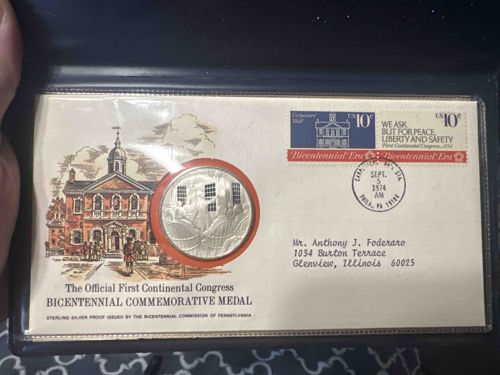
This item is a commemorative set featuring 'The Official First Continental Congress Bicentennial Commemorative Medal' encased within a First Day Cover. The medal itself is described as a 'STERLING SILVER PROOF ISSUED BY THE BICENTENNIAL COMMISSION OF PENNSYLVANIA'. An illustration of a historic building, likely Independence Hall given the theme, is prominently displayed on the left side of the envelope, colored in earthy tones of red-brown for the brickwork and lighter shades for the sky and architectural details. A circular cutout on the envelope provides a view of the sterling silver medal, which depicts a scene with multiple figures, presumably historical, within a room. The medal's surface appears to be a bright, reflective silver, indicative of its 'proof' status, suggesting a high-quality strike with mirrored fields and frosted devices.
The First Day Cover features two U.S. postage stamps, each valued at '10¢', with themes related to 'Bicentennial Era' and 'WE ASK BUT FOR PEACE LIBERTY AND SAFETY'. A circular postmark is visible, dated 'SEPT. 5 1974 AM', and originates from 'PHILA., PA 19106', confirming it as a First Day of Issue marking from Philadelphia. The envelope is addressed to 'Mr. Anthony J. Foderaro, 1034 Burton Terrace, Glenview, Illinois 60025'. The overall item is presented within a dark blue or black display case with a velour or felt-like lining, suggesting it was intended for presentation and preservation. The condition of the envelope and its contents appears to be very good, with no obvious creases, tears, or significant discoloration. The medal itself also appears to be in excellent condition, protected by the envelope's cutout and presumably a clear covering. The clear plastic cover over the envelope shows some minor reflections, but no significant damage or wear to the underlying materials. This item represents a historical commemorative piece from the American Bicentennial, specifically marking the First Continental Congress.
AI Appraisal Report
I have virtually examined this First Continental Congress Bicentennial Commemorative Medal in a First Day Cover. The overall condition appears to be very good to excellent. The envelope shows no obvious creases, tears, or significant discoloration. The stamps are intact, and the First Day of Issue postmark from Philadelphia on September 5, 1974, is clear and authentic. The sterling silver proof medal, visible through the cutout, exhibits the expected reflective 'proof' fields and frosted devices, indicative of a high-quality strike. The original display case also appears well-preserved.
From a market perspective, commemorative medals and First Day Covers from the Bicentennial era are relatively common. While this piece is a sterling silver proof, increasing its intrinsic value due to the silver content (approx. 1 troy ounce), the collector market for such combined items is generally stable but not highly speculative. Comparables for similar Bicentennial-era sterling silver medals in First Day Covers typically range from $30 to $70, depending on condition and specific issue. The demand is moderate, primarily from collectors of American history commemoratives or philatelists. Rarity is not a significant factor here, as these were mass-produced for the Bicentennial.
Factors significantly impacting value include the sterling silver content and the excellent preserved condition. Authentication of the medal's silver content and fineness would ideally require a specific gravity test or XRF analysis. Full authentication would also ideally involve examining the weight and dimensions of the medal, and verifying it against known specifications for this particular issue. Without physical inspection, I cannot account for any subtle toning or minor surface imperfections on the medal, nor can I definitively confirm the sterling silver mark without a clearer view or physical examination. Based on visual evidence, the item appears authentic for its stated purpose.