AI estimate as of October 29, 2025 · verify with a professional before acting
AI-Generated · Verify before acting
Everything on this page is generated by AI for informational purposes only. AI can make mistakes — the AI may misidentify items or misattribute them (artist, maker, brand, designer, origin, era). This is not an official valuation and should not be used for insurance, sale, tax, estate, legal, or lending purposes — or any decision requiring a certified appraisal. It is not an authoritative claim about any person, brand, or rights holder — do not share or rely on it as a factual statement about a third party. Always consult qualified professionals before making financial decisions.
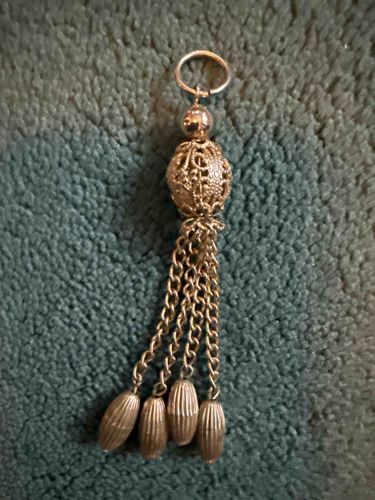
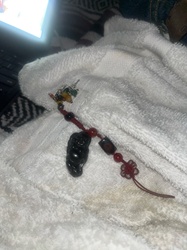
This item is a decorative metal charm or a component of a keychain, characterized by its intricate design and chain tassel structure. The primary material appears to be a silver-toned base metal, possibly an alloy, with a slightly dulled, aged patina suggesting some wear or intentional antiquing. It measures approximately 3-4 inches in total length. The top element is a jump ring, securely attached to a smaller, smooth spherical bead. Below this bead is the central feature: a hollow, spherical filigree bead. This filigree bead exhibits an openwork design with ornate scrolls and possibly floral or geometric patterns, giving it a lacy, delicate appearance. The craftsmanship of the filigree suggests it was either cast or intricately assembled from wirework. Suspending from the bottom of this filigree sphere are five individual chains of equal length. Each chain is a fine-link type, and at the end of each chain is an elongated, ridged bead. These terminal beads are cylindrical with rounded ends and feature horizontal grooves or fluting around their circumference. The general condition appears good, with no obvious breaks or missing components, though the metallic luster has somewhat diminished over time. There are no discernible maker's marks or signatures visible from the image. The style suggests a piece that could be from the mid to late 20th century, possibly having a vintage aesthetic, and it would likely serve as an accent piece for a bag, a cluster of keys, or even incorporated into jewelry.
AI Appraisal Report
I have visually examined the provided image of this Filigree Tassel Charm or Keychain. My assessment indicates a decorative accessory crafted from a silver-toned base metal, likely an alloy, exhibiting a dulled patina consistent with age or intentional antiquing. The overall condition appears good, with no evident damage or missing components, though the metallic luster has diminished. Authenticity, based solely on this image, seems straightforward for what it presents—a mass-produced, vintage-style charm. However, without physical inspection, I cannot confirm the exact metal composition or rule out any subtle repairs. The craftsmanship, particularly the filigree work and chain assembly, suggests standard manufacturing techniques rather than artisanal handcrafting.
Market conditions for such items are generally modest. Similar vintage-style base metal charms and keychains, often referred to as 'costume jewelry' or 'decorative accessories,' typically sell in a lower price bracket. Comparables found in online marketplaces (e.g., Etsy, eBay) or vintage shops show a wide price range, heavily influenced by brand (if any), actual material composition (e.g., sterling silver vs. base metal), and perceived age. This item lacks any discernible maker's marks, which significantly limits its potential for higher value as a collectible branded piece. Demand for such general vintage charms is moderate, driven by individuals seeking unique, affordable accessories or components for craft projects. Rarity is low; similar designs were widely produced in the mid to late 20th century.
Factors significantly impacting value are the base metal composition, absence of maker's marks, and the item's common vintage aesthetic rather than a unique, high-end design. For a full authentication and more precise appraisal, an in-person examination would be critical to confirm material via metallurgical testing, assess the quality of assembly firsthand, and search for any hidden marks. Provenance documentation would be useful if it claimed a significant origin, but for an item of this type, it's unlikely to exist or add substantial value.