These notes were written by the person who submitted this item. Appraiser.AI has not verified them, and the AI's identification and estimate may rely on them.
AI Estimated Value
Not an official valuation
$30-50
AI estimate as of July 10, 2025 · verify with a professional before acting
AI-Generated · Verify before acting
Everything on this page is generated by AI for informational purposes only. AI can make mistakes — the AI may misidentify items or misattribute them (artist, maker, brand, designer, origin, era). This is not an official valuation and should not be used for insurance, sale, tax, estate, legal, or lending purposes — or any decision requiring a certified appraisal. It is not an authoritative claim about any person, brand, or rights holder — do not share or rely on it as a factual statement about a third party. Always consult qualified professionals before making financial decisions.
This analysis also relies on unverified notes provided by the user, which may be incomplete or inaccurate and could affect the result.
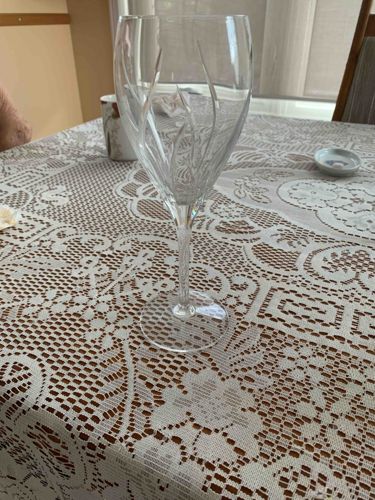
The item is a clear crystal wine goblet featuring an etched or cut glass design on its bowl. The goblet appears to be of standard wine glass size, likely between 7 to 9 inches in height, though precise dimensions are not visible. It is crafted from transparent crystal or high-quality glass, evident from its brilliance and clarity. The design on the bowl consists of delicate, elongated, and somewhat abstract leaf or flame-like patterns that sweep upwards, covering a significant portion of the lower to mid-section of the bowl. These patterns are sharply defined, suggesting either a precise acid-etched or wheel-cut motif, indicative of good craftsmanship. The stem of the goblet exhibits a twisted or ribbed texture, adding an additional decorative element and tactile interest. The base is a plain, circular foot, wider than the stem, providing stability. There are no immediately visible chips, cracks, or significant abrasions on the glass, suggesting it is in good condition, possibly with minor surface wear consistent with age or gentle use. No discernible maker's marks or signatures are visible in the provided image. The style implies a mid-to-late 20th-century aesthetic, possibly vintage, leaning towards a more decorative rather than minimalist design. The overall quality seems good given the clear material and detailed design work on both the bowl and the stem.
AI Appraisal Report
Based on my visual examination of the provided image, this crystal wine goblet exhibits characteristics of good quality craftsmanship. The clarity and brilliance of the material suggest it is indeed crystal or high-quality glass. The etched or wheel-cut design on the bowl, featuring delicate, upward-sweeping patterns, is precise. The twisted stem adds a distinctive decorative element. The goblet appears to be in good condition, with no visible chips, cracks, or significant abrasions, which positively impacts its value.
Authenticity, in terms of material (crystal vs. glass) and specific manufacturer, cannot be definitively determined from an image alone. Without a maker's mark, it's challenging to attribute it to a specific luxury brand. The style suggests it is a vintage piece, likely mid to late 20th century.
Market conditions for vintage crystal drinkware are generally steady but not experiencing a significant boom. Items from renowned manufacturers with clear provenance tend to fetch higher prices. This piece, while aesthetically pleasing, lacks immediate brand identification. Comparables in the market for unsigned, good-condition etched crystal goblets of this era typically range from modest to moderate. Demand for such pieces is present among collectors of vintage glassware and those seeking unique table settings, but it's not considered rare.
Factors impacting value include its good condition, attractive design, and apparent quality. However, the lack of a discernible maker's mark and specific provenance limits its top-tier market value.
For a full authentication and more precise valuation, an in-person examination would be crucial to assess the glass quality (e.g., lead content for crystal verification), detect subtle imperfections not visible in photos, and search for unphotographed marks. Provenance documentation (e.g., original receipts, family history) would also significantly enhance its value by confirming its history and origin.