AI estimate as of August 11, 2025 · verify with a professional before acting
AI-Generated · Verify before acting
Everything on this page is generated by AI for informational purposes only. AI can make mistakes — the AI may misidentify items or misattribute them (artist, maker, brand, designer, origin, era). This is not an official valuation and should not be used for insurance, sale, tax, estate, legal, or lending purposes — or any decision requiring a certified appraisal. It is not an authoritative claim about any person, brand, or rights holder — do not share or rely on it as a factual statement about a third party. Always consult qualified professionals before making financial decisions.
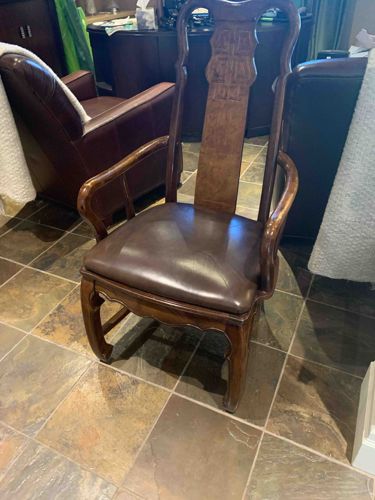
This is a wooden armchair with a distinctive Asian or Chinese Chippendale influence, evidenced by the intricate carving on the back splat and the shape of the legs and armrests. The chair appears to be constructed from a dark-stained hardwood, possibly mahogany or a similar dense wood, exhibiting a rich, warm brown tone with visible wood grain, especially on the back splat. The back features a tall, slightly curved upright with an ornate, three-dimensional carved motif, possibly a stylized ruyi scepter or similar traditional Chinese design, indicating a focus on craftsmanship. The top rail of the back is also subtly curved and shaped. The armrests are gracefully curved, extending from the back posts and sweeping down to connect with the front legs, showcasing a fluid, elegant line. The seat is upholstered in a dark brown, possibly faux leather, material that appears to be well-padded and is consistent in color with the overall wood finish, presenting a cohesive aesthetic. The legs are cabriole-style at the base of the seat frame, transitioning to a straight, tapered form. The overall construction appears solid, emphasizing durability. The visible condition suggests some minor surface wear consistent with age and regular use, such as slight variations in the wood finish or minor scuffs, but no significant damage or repairs are immediately evident. The quality of the carving and the overall design points to a piece made with attention to detail, likely a production from the mid-20th century or later, designed to evoke classic Asian aesthetics while being suitable for a contemporary interior.
AI Appraisal Report
Upon examining the provided image of this Asian-Inspired Carved Wood Armchair with Faux Leather Seat, I assess its condition as good, consistent with age and regular use. Minor surface wear, scuffs, and variations in wood finish are observable, but no significant damage or repairs are immediately evident. The intricate carving on the back splat, likely a stylized ruyi scepter, and the cabriole legs suggest a Chinese Chippendale influence, indicating a focus on craftsmanship. Authenticity, based solely on visual examination, suggests a mid-20th-century or later production evoking classic Asian aesthetics. The dark-stained hardwood, possibly mahogany, coupled with the dark brown faux leather seat, provides a cohesive and durable aesthetic.
In terms of market conditions, there is a steady demand for well-preserved, aesthetically pleasing Asian-inspired furniture. Comparable pieces of good quality, often found in vintage and antique markets, tend to sell within a specific range. While not exceedingly rare, the quality of the carving and solid construction contribute to its desirability. The primary factors impacting value are its good condition, the detailed carving, and its strong presentation. The faux leather, while practical, does not command the same premium as genuine leather or fine upholstery.
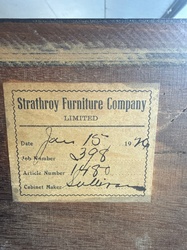
Limitations in authenticity verification are inherent when appraising from images alone. A definitive authentication would require a physical inspection to verify wood species, construction techniques (e.g., joinery), and to search for maker's marks or labels. Provenance documentation could also indicate the chair's history and origin, while scientific testing (e.g., carbon dating for precise age determination of wood) is typically beyond the scope of a standard appraisal for such an item but could be used in extreme cases.