AI Appraisal Estimate

AI-generated estimates · not official valuations

From the user

What was submitted

Photo and notes provided by the user — not generated by AI

Submitted item photo
Submitted photo · May 18, 2026

User's notes

Carlos Scliar, 1976

AI analysis below

AI appraisal

AI analysis & estimate

AI-Generated · Verify before acting

Everything below is generated by AI for informational purposes only. AI can make mistakes — the AI may misidentify items or misattribute them (artist, maker, brand, designer, origin, era). This is not an official valuation and should not be used for insurance, sale, tax, estate, legal, or lending purposes — or any decision requiring a certified appraisal. It is not an authoritative claim about any person, brand, or rights holder — do not share or rely on it as a factual statement about a third party. Always consult qualified professionals before making financial decisions.

Note

This analysis also relies on unverified notes provided by the user, which may be incomplete or inaccurate and could affect the result.

Read the full disclaimer

AI Identification

·Not independently authenticated·Verify before acting

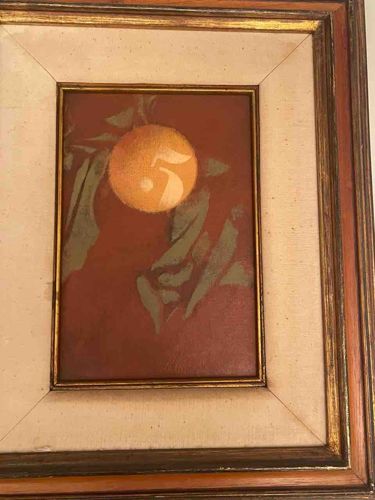
Still Life with Orange and Leaves by Carlos Scliar (1976)

Fine Art - Painting

AI Estimated Value

·Not an official valuation·Verify before acting

$4,500 - $6,500

As of May 18, 2026

AI Item Analysis

·AI can make mistakes·Verify before acting
This is an original still life painting by the renowned Brazilian artist Carlos Scliar, dated to 1976. The composition features a singular, vibrant orange fruit positioned centrally against a deep terracotta or russet-colored background. Surrounding the fruit are stylized, olive-green leaves executed with the artist's characteristic graphic and almost collage-like aesthetic. The work likely utilizes Scliar’s signature 'vinilite' or mixed media technique on paper or board, which allows for flat, matte areas of color combined with textured layering. The orange itself shows a highlight in the shape of a numeral or abstract glyph, a common trope in Scliar's mid-70s graphic period. The piece is presented in an elaborate multi-tiered frame typical of the era. The innermost border is a thin gilded bead, followed by a wide, off-white fabric or linen-textured mat with beveled edges. The outer frame is constructed of dark-stained wood with decorative gold-leaf accents along the primary moulding. Regarding condition, the artwork appears well-preserved under glass; however, there are visible age-related issues on the linen mat, including small brownish spots (foxing) or humidity stains particularly on the left and bottom-left sections. The frame shows minor surface wear and some dust accumulation in the crevices, consistent with its age. Scliar’s mastery is evident in the balanced tension between the organic subject and the rigid, geometric framing of the color planes.

AI Appraisal Report

·AI can make mistakes·Verify before acting
I have virtually examined this 1976 still life by Brazilian modernist Carlos Scliar. The work exemplifies Scliar’s 'vinilite' period, characterized by a sophisticated interplay of graphic design and painterly texture. The composition's use of a central orange with a stylized glyph-like highlight is a trademark motif of his mid-career peak. While the artwork appears stable, the linen matting exhibits significant foxing and humidity-induced staining. While this does not necessarily devalue the artwork itself, it necessitates a full archival reframing to prevent acid transfer to the substrate. The frame’s period-correct aesthetic is attractive but secondary to the preservation of the medium. Scliar’s market remains robust in Brazil and is gaining international traction among collectors of South American modernism. Comparables for works of this scale and period routinely fetch between $4,000 and $8,000 at auction. This specific piece’s value is tempered slightly by the visible moisture damage to the surround, which suggests a need for professional conservation assessment. Limitations: This appraisal is based on digital images and cannot definitively confirm authenticity or condition. A physical inspection is required to verify the 'vinilite' medium, check for paper undulation, and examine the verso for Scliar’s characteristic signature and dating. Full authentication requires provenance documentation (e.g., certificates from a reputable gallery or the Scliar Foundation) and potentially ultraviolet (UV) examination to detect any undisclosed repairs or overpainting. The value assumes the work is authentic and the foxing has not yet migrated from the mat to the primary paper support.

Get your items appraised

Instant estimates of your treasures with AI-powered appraisals

Browse More Appraisals