AI estimate as of October 12, 2025 · verify with a professional before acting
AI-Generated · Verify before acting
Everything on this page is generated by AI for informational purposes only. AI can make mistakes — the AI may misidentify items or misattribute them (artist, maker, brand, designer, origin, era). This is not an official valuation and should not be used for insurance, sale, tax, estate, legal, or lending purposes — or any decision requiring a certified appraisal. It is not an authoritative claim about any person, brand, or rights holder — do not share or rely on it as a factual statement about a third party. Always consult qualified professionals before making financial decisions.
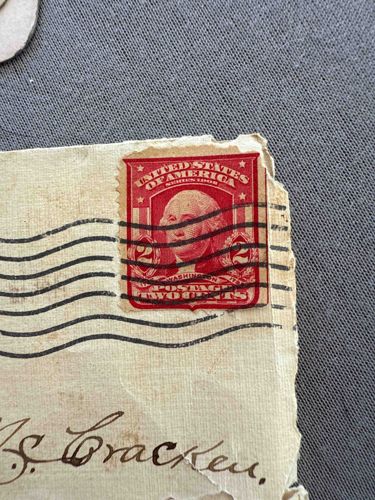
This item is a 2-cent United States postage stamp, depicting George Washington, still affixed to a section of its original postal cover (envelope). The stamp itself is rectangular, predominantly crimson red in color, with a serrated or 'perforated' edge, indicating it was separated from a sheet of similar stamps. The central vignette features a profile bust of George Washington, facing left, rendered with fine detail. Above Washington's portrait, the words 'UNITED STATES OF AMERICA' are printed in an arched banner, and below the portrait, 'WASHINGTON' is visible. The denomination '2 CENTS' (or 'TWO CENTS') is clearly inscribed at the bottom. The stamp has been cancelled with bold, black wavy lines, a common postal marking indicating it has been used. This cancellation pattern covers a significant portion of Washington's face and extends onto the envelope, demonstrating genuine postal use. The fragment of the cover to which the stamp is attached is made of a light, off-white paper, exhibiting signs of age such as slight discoloration and some visible paper fibers, suggesting a relatively basic paper quality typical for its era. The edges of the paper fragment are irregularly torn, further evidence of it being removed from a larger envelope. Below the stamp, a portion of elegant, handwritten cursive script in dark ink is visible, appearing to be part of an address or recipient's name, specifically 'S. Cracker'. Based on the design and denomination, this stamp is likely from the early 20th century, possibly part of the Washington-Franklin issue (1908-1922). The stamp's condition appears fair to good for a used postal artifact, with clear cancellation and good color retention, although the attached cover fragment shows wear and tear consistent with its age and former function. The craftsmanship of the stamp printing is evident in the detailed portrait and crisp lettering, common for governmental issues of that period.
AI Appraisal Report
Upon examining the image provided, I have assessed a United States 2-cent George Washington stamp on a partial cover. Based on the design, this stamp is likely Scott #499, issued in 1917, a very common stamp from the Washington-Franklin series. The stamp appears to be in fair, used condition. The cancellation is heavy, obscuring facial details, which diminishes collector appeal. The 'on-cover' aspect, normally a value-enhancer, is minimal here; it is merely a fragment, not a full cover with a clear postmark, date, and complete address that would provide historical context.
The item appears authentic for what it is—a common, postally used stamp. However, its value is nominal due to extreme abundance. Millions of these stamps were printed and used. The market for such items is limited to beginners or bulk lot buyers. Comparables for single, used copies of Scott #499, even on partial cover fragments like this one, consistently sell for a minimal amount, often less than one dollar.
The primary factor limiting the value is its commonality. There are no discernible errors or rare variations visible in the image that would elevate its status. The heavy, non-descript cancellation and the torn, partial nature of the cover also significantly depress its value.
It is important to note the limitations of an appraisal based solely on images. While it appears to be a genuine Scott #499, I cannot physically measure the perforations, examine the paper type, or check for watermarks which are critical for distinguishing between varieties in the Washington-Franklin series. Full authentication would require in-person examination to confirm the exact Scott catalog number and to rule out any potential alterations not visible in a photograph.